

Cloud Gaming's Promise and GeForce Now's Reality
Cloud gaming has long been pitched as the inevitable future of interactive entertainment. The idea is simple: instead of buying expensive hardware, players stream games from remote data centers to whatever screen they already own. Nvidia GeForce Now is one of the most prominent services in this space. It allows users to connect their existing Steam, Epic Games, and Xbox libraries, then play supported titles on a PC, Mac, laptop, handheld, or mobile device. On paper, it is a compelling proposition: a small monthly fee for access to a virtual gaming PC, with no need to repurchase games.
But the gap between the pitch and the reality can be wide. Nvidia GeForce Now offers three main subscription tiers, each with different hardware, resolution targets, and session limits. The free tier is ad-supported, caps sessions at one hour, and targets 1080p at 60 frames per second. The Performance tier costs $9.99 per month, removes ads, targets 1440p at 60fps, and extends sessions to six hours. The Ultimate tier costs $19.99 per month, targets up to 5K at 360fps, and allows eight-hour sessions. Paid tiers also promise priority queues and access to RTX GPUs.
Those promises sound impressive. In practice, however, the service frequently struggles with queue times, input delay, inconsistent streaming quality, and a catalog that is more limited than many players expect. For a service that asks users to pay a premium for convenience, those problems are difficult to ignore.
Key Facts
- Nvidia GeForce Now streams PC games from a user's existing Steam, Epic Games, or Xbox library.
- The service offers Free, Performance ($9.99/month), and Ultimate ($19.99/month) tiers.
- Paid tiers advertise priority queues, RTX hardware, higher resolutions, and longer sessions.
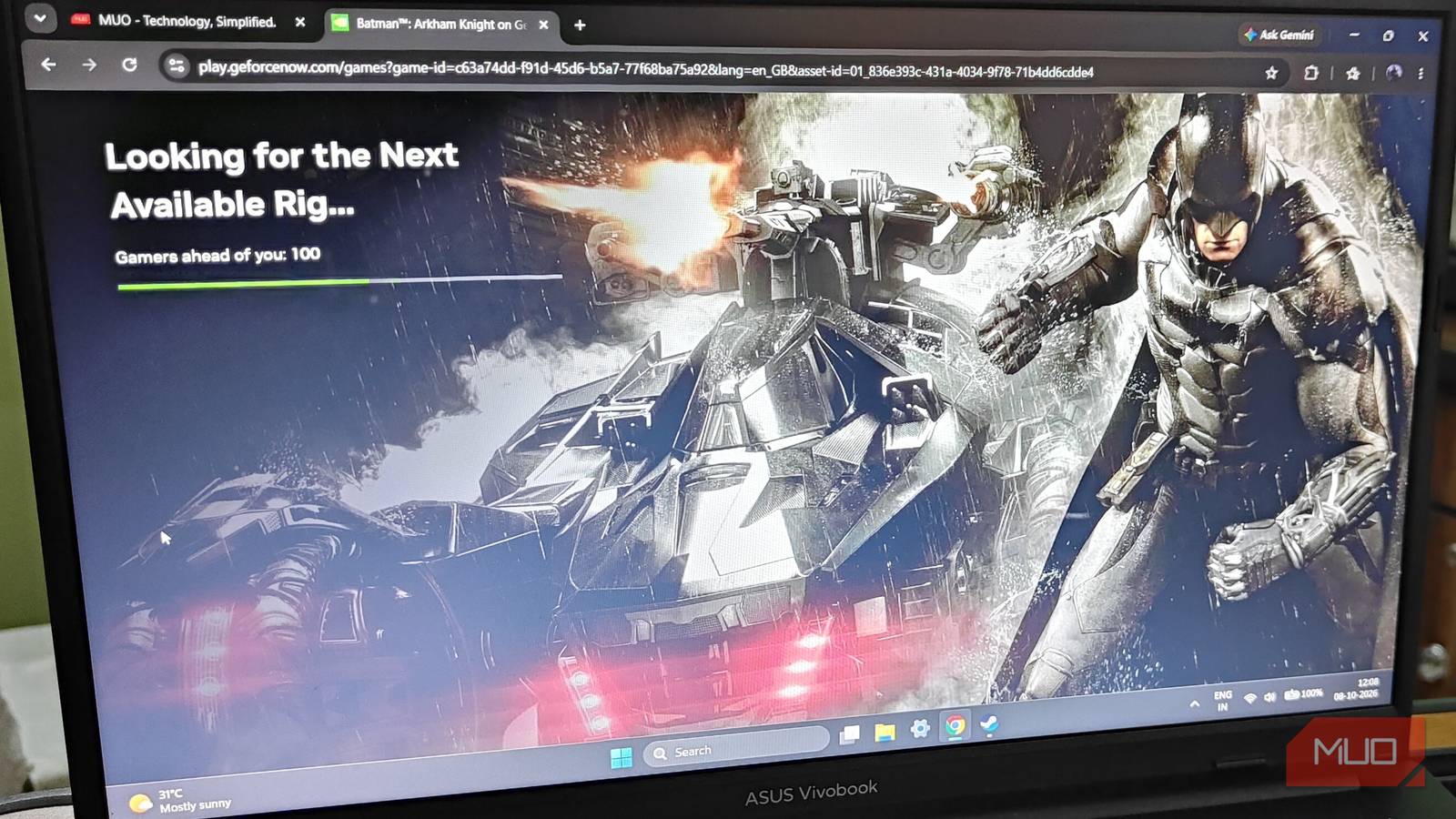
- Real-world use often includes long waits, even on paid plans, with some users reporting 10 to 15 minute queues.
- Streaming quality can fluctuate between 1080p and 1440p, and input lag remains noticeable for many players.
- The game catalog is limited to titles that explicitly support Nvidia's platform. Major publishers such as FromSoftware are absent.
- Alternatives include Xbox Cloud Gaming, Amazon Luna, and Boosteroid.
- Cloud gaming remains an alternative to dedicated hardware rather than a full replacement.
What GeForce Now Gets Right
GeForce Now's core idea is strong. Unlike Google Stadia, which required players to buy games again on a new storefront, GeForce Now works with libraries that players already own. That alone removes a major barrier to entry. A user with a large Steam backlog can sign in, find a supported game, and start playing without purchasing another copy. The service also avoids the hardware lottery of PC gaming: no need to upgrade a graphics card, install drivers, or manage storage space. For someone with an aging laptop or a handheld device, that flexibility is genuinely valuable.
The tier structure is also straightforward. The free tier provides a way to test the service. The Performance tier offers a reasonable middle ground for 1440p play. The Ultimate tier is aimed at enthusiasts who want the highest possible frame rates and resolution. When everything works, GeForce Now can feel like a window into a high-end gaming rig. Games such as Cyberpunk 2077, Street Fighter 6, Forza Horizon 6, Control Resonant, Dragon's Dogma 2, and Monster Hunter Wilds can be streamed with impressive visual settings, assuming the network and server cooperate.
Nvidia's data centers are capable of delivering strong performance. The problem is not the theoretical ceiling. The problem is consistency. Cloud gaming depends on a chain of technologies: the game server, the encoder, the network path, the client decoder, and the local display. Any weak link can degrade the experience. GeForce Now can be excellent one day and frustrating the next, and that variability is the opposite of what a premium subscription should offer.
Subscription Tiers and Promises
The three tiers are designed to serve different audiences. The free tier is an entry point, but it comes with ads, one-hour sessions, and no priority queue. It targets 1080p at 60fps and provides 4-core vCPUs with 16 GB of DRAM. RTX features are not available.
The Performance tier costs $9.99 per month. It removes ads, targets 1440p at 60fps, and allows six-hour sessions. It includes priority queue access, 8-core vCPUs, 28 GB of DRAM, and access to RTX GPUs. This is the tier most users consider the sweet spot for price and performance.
The Ultimate tier costs $19.99 per month. It targets up to 5K at 360fps, though actual results depend on the game, network, and display. It allows eight-hour sessions, includes priority queue access, and provides 16-core vCPUs with 56 GB of DRAM. RTX access is included. For players who want the closest thing to a high-end gaming PC, this is the top option.
Yet the promised benefits do not always materialize. Priority queue access does not guarantee instant play. Higher resolutions do not guarantee a stable image. RTX hardware does not guarantee a flawless frame rate. When a service charges monthly, users expect reliability. GeForce Now does not always deliver it.
Where the Experience Breaks Down
The first month of GeForce Now can be genuinely enjoyable. A user may find themselves playing more on the service than on their own gaming PC. The convenience of launching a game on a work laptop or a Steam Deck is real. The appeal of trying demanding titles without installing them locally is obvious. But after that initial honeymoon period, problems tend to surface.
Queue times are among the most visible issues. Even the Performance tier, which advertises less than a minute of wait between sessions, can produce lengthy queues. The Ultimate tier is not immune. Testing the top plan can still result in waits of roughly 10 minutes before playing games such as The Witcher 3: Wild Hunt Remastered or Monster Hunter Wilds. Long queues are not unique to GeForce Now, but they are especially frustrating when a premium subscription explicitly promises minimal waiting.
Streaming quality is another weak point. On Performance and Ultimate tiers, visuals can look impressive when conditions are ideal. Most of the time, however, the image may sit somewhere between 1080p and 1440p. That is not terrible, but it is not the premium experience that the price suggests. Compression artifacts, blur during motion, and soft textures can appear. For fast-paced games, those issues are more than cosmetic. They affect visibility and reaction time.
Input delay is perhaps the most fundamental challenge. Whether using a keyboard and mouse or a controller, some degree of lag is usually present. Cloud gaming always introduces additional latency compared with local play, but the amount varies. In some sessions, the delay is subtle. In others, it is distracting. Fighting games, shooters, and precision platformers suffer the most. A player can adjust, but the adjustment is a compromise, not a feature.
Hardware dependence is also surprising for a cloud service. On a powerful desktop PC connected to the same network as an older laptop, streaming hitches may be less frequent and resolution may stay closer to 1440p. On the older laptop, the same service can struggle. This suggests that the client device still matters a great deal, even though the actual game is running in a data center. Wi-Fi chips, network stacks, decoding hardware, and background processes all influence the experience. GeForce Now is not as hardware-agnostic as its marketing implies.
Catalog Limitations
Nvidia claims that GeForce Now supports most major releases from the last four to five years. The reality is more complicated. The catalog is limited to games that explicitly support the platform. Publishers must opt in, and not all do. The result is a library that can feel uneven. Many supported titles are free-to-play games that are also available on mobile phones, which weakens the value proposition for players seeking premium single-player experiences.
Some niche titles are available, such as Lost Ark and Path of Exile. But entire publisher catalogs can be missing. FromSoftware is a notable example. Dark Souls, Elden Ring, and other acclaimed titles are not available on GeForce Now. For players whose tastes run toward those games, the service simply cannot serve as a primary platform. The catalog gap is not a minor inconvenience. It is a structural limitation that no amount of server hardware can fix.
This licensing model also creates uncertainty. A game may be supported today and removed later. Publishers can change their minds. A cloud library is never truly owned by the player. That uncertainty makes it harder to rely on GeForce Now as a long-term home for a game collection, even if the technology works perfectly.
Better Alternatives to GeForce Now
GeForce Now is not a bad service in every scenario. When it works as intended, it can be one of the best cloud gaming options for its price. But when it fails, users are left with long queues, limited playtime, and inconsistent streaming. Fortunately, there are alternatives worth considering.
Xbox Cloud Gaming
Xbox Cloud Gaming is included with Xbox Game Pass Ultimate and PC Game Pass at $23.99 per month. It does not require an add-on. It provides access to the Xbox library and the Game Pass catalog. Supported platforms include Windows, Xbox Series X|S, Xbox One, and mobile devices. In practice, it can offer a smoother experience than GeForce Now, with less concern about latency and streaming quality. The trade-off is that it is tied to Microsoft's ecosystem and Game Pass catalog rather than a user's existing Steam library.
Amazon Luna
Amazon Luna is included with an Amazon Prime subscription. A premium tier is available as an add-on for $9.99. The catalog is smaller than some competitors, but it includes select triple-A and indie titles. Supported platforms include Windows and mobile. For Prime members, Luna can be a low-friction way to try cloud gaming without a large additional commitment. The limitation is the catalog size and the fact that it does not stream a user's existing PC library.
Boosteroid
Boosteroid offers an Ultra tier at $16.89 per month. An Ultra Pro upgrade is available at $74.89 for six months or $134.89 for twelve months. The service provides select triple-A titles and free-to-play games from the user's own Steam library. Supported platforms include Windows, Linux, Tizen, WebOS, and mobile. Boosteroid may appeal to players who want access to their Steam games across a wide range of devices, though its catalog and performance can vary by region.
Each alternative has caveats, whether a limited library, a higher subscription price, or platform restrictions. None is perfect. But together they show that GeForce Now is not the only option. For some users, Xbox Cloud Gaming is a better fit. For others, Luna or Boosteroid may fill a specific need. The best choice depends on the games a player wants, the devices they own, and the quality of their network connection.
Cloud Gaming's Place in the Market
Cloud gaming remains a fascinating technological proposition. It promises to remove hardware barriers and let people play demanding games on devices that could never run them locally. Given the current market for PC components and consoles, that promise has real appeal. For players who cannot afford a dedicated gaming rig, cloud services can be a superb alternative. They can also be useful for travel, short sessions, and trying games without large downloads.
At the same time, cloud gaming is still in its infancy. Latency, bandwidth, server capacity, licensing, and client hardware all create friction. The technology is improving, but it is not yet a seamless replacement for local play. Services like GeForce Now and Xbox Cloud are best understood as alternatives, not as universal solutions. They can be relied on when traveling or when a main system is unavailable. They are less suited to players who demand consistent competitive performance or who want guaranteed access to every game in their library.
There is also the question of ownership. A local PC or console is a system that a player controls. Games can be installed, modded, and played offline. A cloud service depends on servers, licenses, and network conditions. Even when the experience is good, it is fundamentally rented. That difference matters to many players. It may matter less to those who value convenience above all, but it is a real trade-off. GeForce Now illustrates both the potential and the limits of cloud gaming. It shows how close the future might be, and how far it still has to go.
Source: MakeUseOf News