

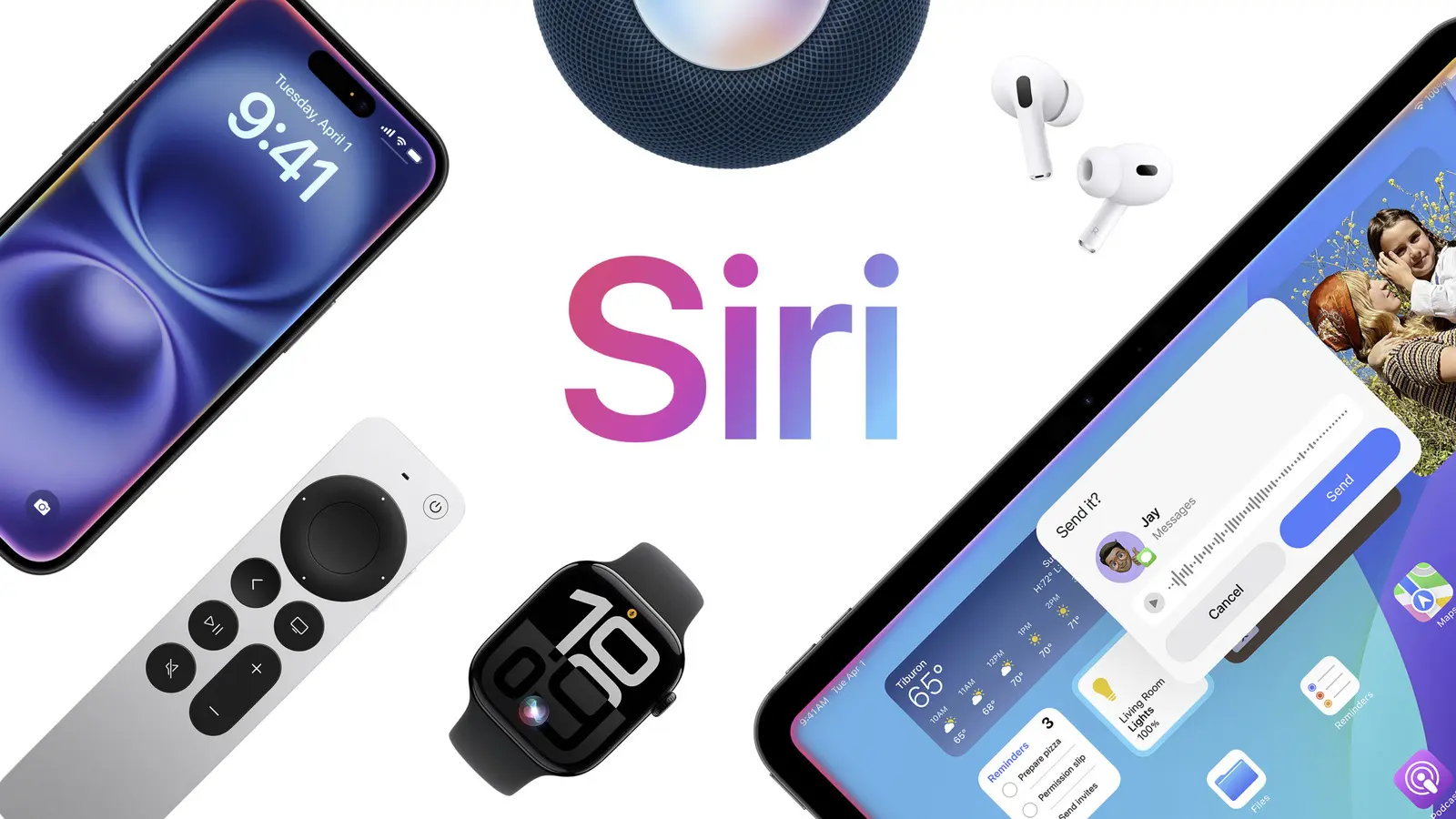
Apple has agreed to pay $250 million to settle a class-action lawsuit that accuses the company of misleading iPhone buyers in the United States about the availability of its AI-powered Siri. The settlement, first reported by The Financial Times, stems from claims that Apple promised a significantly upgraded version of Siri alongside its Apple Intelligence suite at WWDC 2024, but has failed to deliver that update nearly two years later.
The new Siri was marketed as a more personalized and context-aware assistant, capable of understanding what is on a user's device and taking actions within apps on their behalf. It was supposed to launch in 2024, but Apple has not yet shipped the feature. The class action covers US buyers of the iPhone 16 lineup and the iPhone 15 Pro, who expected the enhanced Siri to be available on their devices. If approved by a judge, the settlement will provide financial compensation to affected consumers, though Apple is not required to admit any wrongdoing.
Background of the Lawsuit
The lawsuit centers on Apple's advertising and marketing for the iPhone 16, which heavily promoted Apple Intelligence as a key differentiator. Apple Intelligence was unveiled at the Worldwide Developers Conference (WWDC) in June 2024, with promises of advanced text editing, image generation, ChatGPT integration, and a revolutionary new Siri. While Apple slowly rolled out some components of Apple Intelligence throughout 2024 and 2025—such as writing tools, photo cleanup, and AI-generated emoji—the centerpiece Siri update never materialized.
Plaintiffs argued that Apple knew or should have known that the Siri upgrade would be significantly delayed, yet continued to sell iPhones based on the promise of the feature. The company did not publicly acknowledge the delay until March 2025, more than five months after the iPhone 16 launch. By that time, millions of consumers had already purchased devices based on the expectation that they would receive the AI assistant.
Apple later pulled advertisements that showed the new Siri features in action, suggesting the company recognized the gap between its marketing and the actual product timeline. The settlement avoids a protracted legal battle and the risk of a larger damages award, though it also spares Apple from having to admit fault—a common feature of corporate settlements.
The Siri Promise and Its Delay
Apple's vision for a truly intelligent Siri has been years in the making. The company acquired several AI startups and invested heavily in on-device machine learning to enable features that work without sending user data to the cloud. The new Siri was designed to understand context, such as a user's calendar, messages, and browsing history, and to perform complex multi-step tasks like booking a flight or editing a photo based on a natural language command.
Yet the technical challenges proved formidable. Apple’s approach to on-device intelligence, while privacy-friendly, limited the processing power available for advanced AI models. Competitors like Google and OpenAI had already deployed cloud-based assistants with similar capabilities, using massive server farms. Apple’s reliance on its own silicon and privacy architecture may have slowed development. In March 2025, Apple finally admitted that the new Siri would be delayed, causing a sharp drop in its stock price and a wave of negative publicity.
The delay also cast a shadow over Apple's broader AI strategy. The company had positioned Apple Intelligence as the future of its ecosystem, integrating AI into every aspect of the user experience. Without the new Siri, that vision felt incomplete. Analysts noted that Apple was losing ground to rivals who were shipping similar features faster. The partnership with Google to use Gemini models, announced later in 2025, signified a shift in Apple’s approach—from purely on-device to a hybrid model that leverages cloud AI while still respecting privacy.
Class Action Details and Settlement Terms
The class action lawsuit was filed in federal court in California and sought damages for false advertising and unfair business practices. Plaintiffs alleged that Apple’s marketing campaigns for the iPhone 16 and iPhone 15 Pro created a reasonable expectation that the new Siri would be available within a year of the devices’ release. When that did not happen, consumers were left with outdated voice assistants that could not perform the advertised tasks.
The proposed settlement of $250 million will be distributed among eligible class members, which include US purchasers of the iPhone 16, iPhone 16 Plus, iPhone 16 Pro, iPhone 16 Pro Max, and iPhone 15 Pro models. Each qualifying consumer may receive a payment, the exact amount depending on the number of claims filed. The settlement also covers legal fees and administrative costs. Importantly, Apple does not admit any liability, and the company maintains that its advertising was not misleading.
Legal experts note that the settlement is significant but not unprecedented. Large tech companies have faced similar lawsuits over delayed or missing features. For instance, Samsung settled a class action over the delayed launch of its Bixby assistant, and Microsoft faced litigation over Windows 10 upgrade promises. The $250 million figure reflects the high volume of iPhone sales in the US and the perceived value of the promised feature.
Impact on Apple’s Reputation and Future
The settlement is a blow to Apple’s reputation for reliability and delivering on promises. The company has long prided itself on polishing features before releasing them, often entering markets later than rivals but with a superior experience. In the case of AI, however, the delay has made Apple appear behind the curve. The new Siri is now expected to ship in 2026 as part of iOS 27—a full two years after the original target.
Apple has reportedly partnered with Google to integrate Gemini models into the new Siri, which could accelerate development. This partnership marks a departure from Apple’s tradition of building core features in-house. It also raises questions about privacy, as cloud-based AI processing typically requires sending data to servers. Apple has stated that it will implement strong privacy safeguards, including differential privacy and on-device processing where possible.
The financial impact of the settlement is manageable for a company with over $200 billion in cash reserves. However, the reputational damage may linger. Consumers and investors will be watching closely to ensure that iOS 27 delivers on the long-promised AI features. Failure to do so could lead to further lawsuits and erode trust in Apple’s product roadmap.
Broader Context: The Race for AI Assistants
Apple’s struggles with Siri are part of a larger industry trend. Voice assistants have been a key battleground for tech giants, but many have failed to meet initial expectations. Amazon’s Alexa has not evolved as quickly as hoped, and Google Assistant has faced internal cutbacks. The rise of generative AI models from companies like OpenAI and Anthropic has set new standards for what assistants can do.
Consumers now expect their digital helpers to understand complex queries, generate creative content, and take actions across multiple apps. Apple’s initial vision for Siri was ahead of its time, but the execution lagged. By 2026, the market may have moved even further, with multimodal AI and real-time reasoning becoming the norm. The partnership with Google could give Apple a shortcut, but it also means relying on a competitor for a core feature.
The $250 million settlement serves as a cautionary tale for any company that overpromises on AI. As technology evolves at breakneck speed, the gap between marketing and reality can become a legal liability. For Apple, the lesson is clear: deliver on promises, or be prepared to pay the price.
Source: Engadget News