

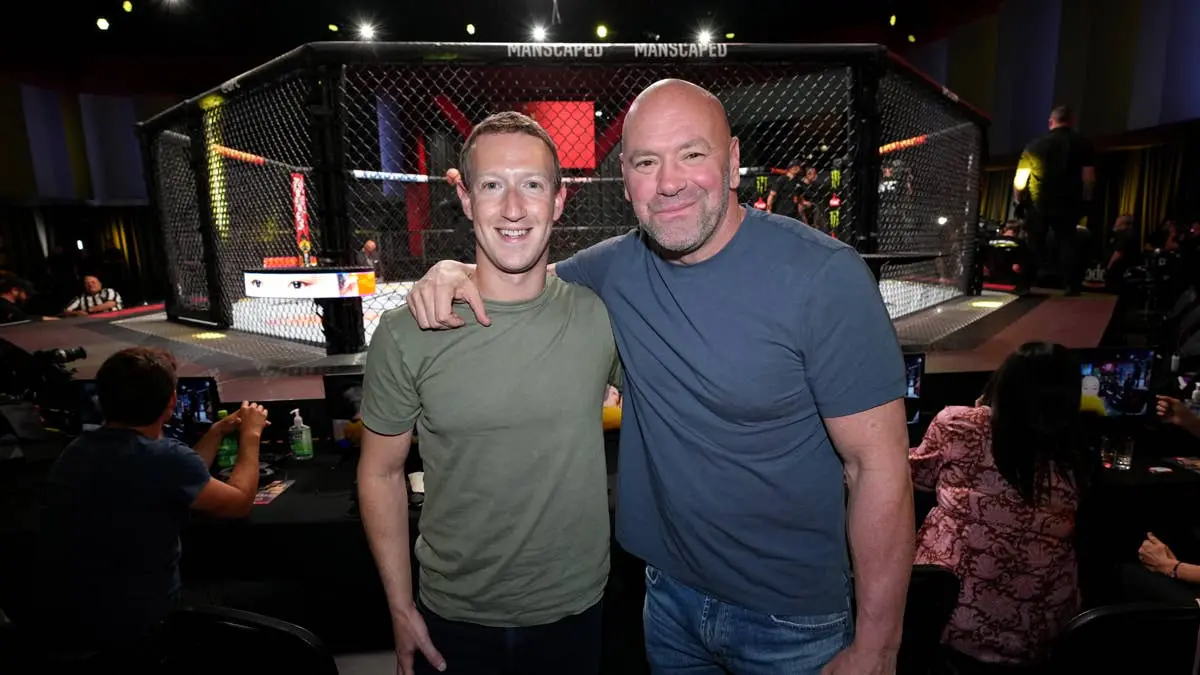
UFC CEO Dana White has finally laid to rest the speculation surrounding a potential mega-fight between tech titans Elon Musk and Mark Zuckerberg. During the post-fight press conference for UFC Fight Night: Kyoji Horiguchi vs. Manel Kape, White provided a detailed account of the serious negotiations that fell through. The billionaire bout, which captured global imagination for months, was more than just a social media spat; it was a real, high-stakes business negotiation that involved international governments and an ancient landmark.
White confirmed that the talks were not a publicity stunt, revealing the extent of his personal involvement. 'That was real. I was literally in my backyard for two weeks negotiating that fight,' White stated, emphasizing the seriousness of the endeavor. The UFC boss disclosed that the primary hurdle was the staggering cost of the proposed venue—the Colosseum in Rome. According to White, the iconic ancient site demanded a fee of approximately $150 million to host the event. This sum was not a standard rental fee but a contribution to a fund dedicated to restoring historic landmarks across Italy. Despite the immense financial commitment, White indicated that both billionaires were prepared to cover the cost. 'Those two were gonna put up the money for the Colosseum,' he said, confirming their serious intent.
The Colosseum Obstacle
The $150 million price tag made the proposed event significantly more expensive than even the UFC's groundbreaking Freedom 250 event at the White House, which reportedly cost around $60 million. For context, the entire UFC 300 event had a budget estimated at tens of millions, but nothing approached this level. The Colosseum's fee, while astronomical, reflected the unique nature of the venue. Built nearly 2,000 years ago, the Flavian Amphitheatre has hosted gladiatorial contests, public spectacles, and now, in modern times, occasional concerts and events. However, hosting an MMA fight inside its ancient walls required special permissions and a hefty restoration fund contribution. White revealed that he participated in conference calls with Italian authorities to make the bout a reality, underscoring the international scope of the negotiations.
This venue choice was not arbitrary. Both Musk and Zuckerberg were attracted to the symbolism and grandeur of the Colosseum, a site synonymous with combat and spectacle. White noted that the idea of the world's richest men settling their rivalry in the same arena where gladiators once fought was too compelling to ignore. Yet, the cost ultimately proved insurmountable, even for two of the wealthiest individuals on the planet. White's comments highlight that the discussions were advanced, involving complex logistical, legal, and financial considerations.
The Serious Negotiations
White's account provides unprecedented insight into how close the fight came to reality. He described a process that consumed two weeks of his life, with daily phone conversations of an hour each with Musk and Zuckerberg. 'I had a blast doing the negotiations with that thing, talking to Elon for an hour every night, talking to Mark an hour every night... [the negotiations were] about the fight, where it would be, weight classes, this, that,' he detailed in a separate interview with Tucker Carlson last year. The negotiations were not just about money; they involved deciding on weight classes, rules (amateur or professional? MMA or boxing?), and even the specific date. Both men trained and expressed willingness to compete. Musk, who has a background in rough-and-tumble play but no formal fight training, and Zuckerberg, who had been actively training in Brazilian Jiu-Jitsu and even competed in a local tournament, both saw the bout as a way to settle their public rivalry.
White's role as a mediator was critical. He had to balance the egos, the physical limitations, and the financial demands. The Colosseum's requirement of $150 million for restoration fund was non-negotiable, and while both billionaires were willing to pay, the overarching complexity of organizing such an event—with security concerns, international media scrutiny, and regulatory approvals—began to outweigh the benefits. 'I was literally doing conference calls with the government in Italy to do this thing in the Colosseum in Rome,' White told Carlson. 'For the right number, the Colosseum was going to let us do that fight there. Eventually, it started to fall apart, but while it lasted it was fun.'
A Brief History of the Rivalry
The fight's origins trace back to June 2023, when Musk challenged Zuckerberg to a cage match on social media. The challenge was sparked by the launch of Meta's Threads, a direct competitor to Musk's X (formerly Twitter). Musk tweeted, 'I'm up for a cage match if he is lol,' and Zuckerberg responded by sharing a screenshot of the tweet with the caption 'Send Me Location.' This public exchange ignited a firestorm of speculation. Within hours, Dana White confirmed that he had spoken to both parties and that the fight was a real possibility. The media frenzy lasted for weeks, with fans and analysts debating who would win, where the fight would happen, and what rules would apply.
The rivalry between Musk and Zuckerberg extends beyond social media platforms. They have clashed over artificial intelligence, space exploration, and the future of online communication. Musk has mocked Zuckerberg's metaverse ambitions, while Zuckerberg has criticized Musk's acquisition of Twitter. The proposed fight was seen as a culmination of this tension, a literal battle of the billionaires that would capture the world's attention. However, despite the public back-and-forth and White's direct involvement, a final agreement was never reached. Other potential venues, such as the Las Vegas Sphere and the UFC's Apex facility, were also discussed, but the Colosseum remained the dream location.
Challenges Beyond Venue
While the Colosseum was the focal point, White also revealed that other logistical issues, like weight class and rules, were points of contention that complicated the deal. Musk, who is taller and heavier, would have had a significant size advantage over Zuckerberg, who is more agile and trained in grappling. Negotiations over weight classes likely involved whether to have a catchweight or an open weight bout. Additionally, the rules—whether to use MMA gloves, smaller cage, or even bare-knuckle—were debated. Both men wanted to ensure they had a competitive advantage, and White had to navigate these discussions delicately.
Another challenge was the involvement of other organizations. The Italian government had to approve the event, and there were discussions about partnering with the Italian Ministry of Culture. Security was a major concern, as the event would have attracted tens of thousands of fans and unparalleled global media coverage. The Colosseum itself required structural assessments to ensure it could host a modern MMA event with a cage, lighting, and broadcasting equipment. All these factors added layers of complexity that ultimately contributed to the deal's collapse.
What Could Have Been
The bout between the world's wealthiest individuals would undoubtedly have drawn a record-breaking audience, even if the skill level displayed by Zuckerberg and Musk would not have been remotely comparable to professional, or even most amateur, MMA fights. However, the spectacle would have been monumental. Analysts predicted pay-per-view buys surpassing 10 million, shattering all previous records. The event would have generated hundreds of millions in revenue for the host city and the UFC. For Rome, it would have been a massive tourism driver, showcasing the Colosseum to a new generation.
White's willingness to entertain the idea remains, but only under one condition: 'Anybody that wants to put up the money for UFC to fight in the Colosseum, I'm in,' he declared during the press conference. This statement keeps the door open for future possibilities, but with the current costs, it seems unlikely. Other celebrities, such as Jake Paul and Conor McGregor, have also expressed interest in high-profile fights, but none have reached the scale of Musk vs. Zuckerberg. The dream for many of seeing these two tech titans settle their rivalry in the Octagon remains a what-if scenario, as White revealed that the battle of the billionaires never left the negotiation table.
The failed negotiations serve as a fascinating case study in modern sports business: how celebrity, social media, and immense wealth can intersect to create a spectacle, but also how practical constraints can derail even the most ambitious projects. As White noted, the process was enjoyable while it lasted, and it gave the public a glimpse into the world of negotiating a mega-fight. For now, Musk and Zuckerberg will continue their rivalry through their companies, and the Colosseum will remain a historical monument rather than a fight venue. But the possibility of such an event in the future, perhaps at a different location or with a different price tag, cannot be completely ruled out. As White said, 'I'm in'—if someone can meet the financial demands.
Source: Yahoo Sports News