

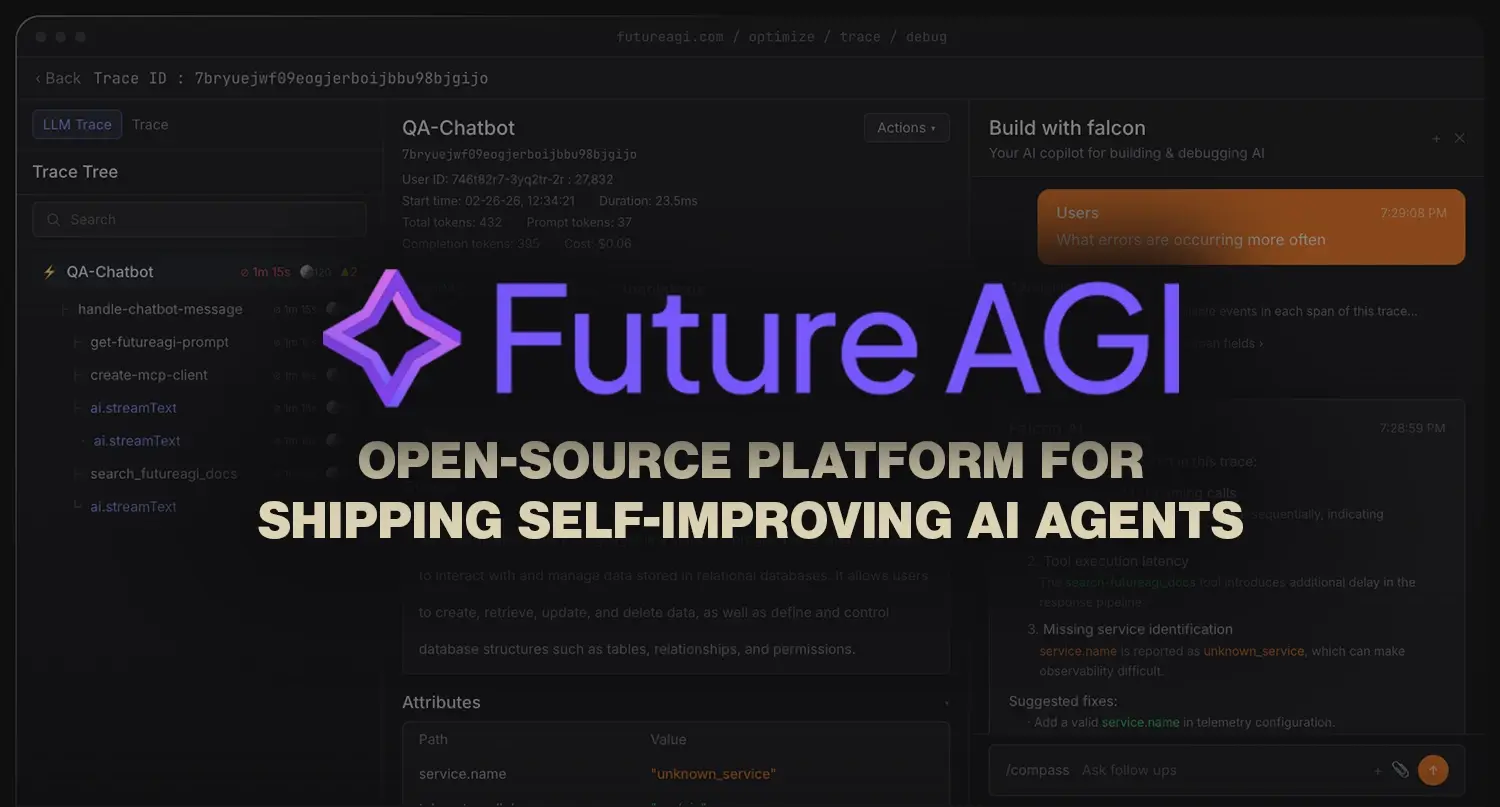
Future AGI has entered the crowded AI infrastructure space with an open-source platform designed for teams that need to ship self-improving AI agents with more control over telemetry, security, and evaluation. The project is licensed under Apache 2.0, can be self-hosted, and combines several capabilities that are usually spread across separate tools: distributed tracing, experiment evaluation, simulation, and guardrailing. The goal is to give developers a single plane where they can observe what an agent does, test changes before deployment, and block harmful or unwanted behavior in production.
Agent development has moved quickly from simple prompt chaining to autonomous systems that call tools, read files, interact with APIs, and make decisions. With that autonomy comes complexity. Teams need to know why an agent chose a particular path, whether a new prompt or model improves performance, and how to keep the agent from leaking sensitive data or executing malicious instructions. Future AGI addresses these needs with a self-hosted stack and an optional telemetry connection to the project's core.
Telemetry and the first-boot registration
One of the first things operators notice about Future AGI is how it handles registration. A self-hosted instance contacts the Future AGI project on first boot and transmits a small set of data: an instance ID, a version string, a deployment type, and the email addresses and domains of active admin users. This registration happens once, before anyone signs in to the dashboard. The project says the opt-out mechanism is an environment variable, FUTURE_AGI_TELEMETRY_DISABLED=1, placed in .env ahead of the first start. If administrators miss that window, the admin list has already left the network.
Future AGI explicitly lists air-gapped and on-premises deployment as supported and describes the system as phone-home free. That language attempts to reassure organizations that do not want any external communication. Disabling telemetry leaves one census ping, still carrying instance ID, version, and deployment type, but with emails withheld. Periodic heartbeats stop. The telemetry section closes with a blunt recommendation for operators: “turn networking off at the edge if you need full silence.”
This design will feel familiar to anyone who has worked with other open-source projects that balance community insight with user privacy. One-time registration is less intrusive than continuous phone-home telemetry, but the requirement to set the opt-out before first boot may still catch teams that install casually. Air-gapped users effectively get full privacy by construction because the instance cannot reach the network at all.
Installation and core architecture
The installer brings up a set of mature backend components behind a dashboard on localhost:3000. ClickHouse serves as the columnar store for trace spans, PostgreSQL handles relational metadata, Redis provides caching, RabbitMQ handles message queuing, and Temporal powers durable workflow execution. This is not a toy stack; it is the kind of architecture usually associated with enterprise-grade observability and orchestration platforms.
Spans land in ClickHouse, where they can be queried at scale. Prompt text, model output, and tool calls pass through the tracer on the way into that store. That means every step of an agent's reasoning process can be replayed and audited. Instrumentation covers 50 or more agent frameworks, including LangChain, LlamaIndex, CrewAI, and DSPy, through OpenTelemetry. OpenTelemetry has become the de facto standard for cloud-native observability, so Future AGI can fit into existing monitoring pipelines instead of forcing a proprietary agent.
The security-oriented component, which the project calls a defender, inherits the access controls on the underlying database along with the traces. This subtle architecture choice matters: instead of duplicating access-control logic in a separate system, the defender operates under the same permissions as the data store. That reduces the chances of accidental privilege escalation or inconsistent policy enforcement.
The choice of ClickHouse is also worth noting. Trace data for LLM agents can be heavy, especially when full prompt text and model outputs are stored for every request. A columnar database is well suited to high-volume write patterns and analytical queries. Keeping PostgreSQL nearby allows for relational joins and metadata management, while Temporal provides durable execution for long-running agent workflows that may span multiple model calls and tool invocations.
The Agent Command Center gateway
A second major component, the Agent Command Center, acts as an OpenAI-compatible proxy that fronts more than 100 providers. The proxy supports routing strategies, semantic caching, virtual keys, MCP (Model Context Protocol), and A2A (Agent-to-Agent) communication. Every provider credential in a deployment terminates there. This creates a single chokepoint for vendor API keys and lets teams rotate keys, apply rate limits, and route requests without modifying application code.
The OpenAI-compatible surface is important for adoption. Many LLM applications are built against OpenAI's SDK, and a proxy that speaks the same protocol can be dropped in without changing client code. Teams can then transparently route to other providers, fall back during outages, or split traffic between models for A/B testing. Semantic caching adds another layer: if an agent asks a question that has already been answered with the same meaning, the proxy can return the cached result instead of calling an expensive model again.
Virtual keys are a useful security feature. Instead of exposing real provider credentials to every developer or service, teams can issue virtual keys that map to specific quotas, budgets, and permissions. This is especially relevant for agent deployments where multiple services may share the same underlying model provider. MCP support also gives agents a standardized way to reach external tools and data sources, avoiding point-to-point integrations.
Protect: guardrails and scanners
The Protect component ships with 18 built-in scanners for PII, jailbreak attempts, and prompt injection. These scanners run inline inside the gateway or standalone through the SDK. Inline scanning is designed for low latency: the project states that P99 latency stays at or under 21 ms on its benchmark harness. For teams that deploy their own models, that level of overhead is usually acceptable when weighed against the risk of data leakage or malicious prompt manipulation.
Vendor adapters cover Lakera, Presidio, and Llama Guard, allowing teams to plug in specialized detection services if they prefer not to rely solely on the built-in scanners. This hybrid approach is common in AI security: some organizations want an open-source baseline, while others have existing enterprise contracts with commercial guardrail providers. The ability to run scanners inline in the gateway means all traffic, including traffic from agents that were not originally designed with security in mind, can be filtered before it reaches the model or after the model returns output.
Prompt injection is one of the most challenging problems in agent security. A hostile instruction hidden in a webpage, document, or API response can trick an agent into performing unwanted actions. Built-in scanners that detect common injection patterns provide a first line of defense. PII scanning helps prevent sensitive data such as email addresses, phone numbers, government IDs, or credit card numbers from being sent to external model providers. Jailbreak detection catches attempts to override system prompts or force the model to ignore safety rules.
Why agent operations need more
Source: Help Net Security News