

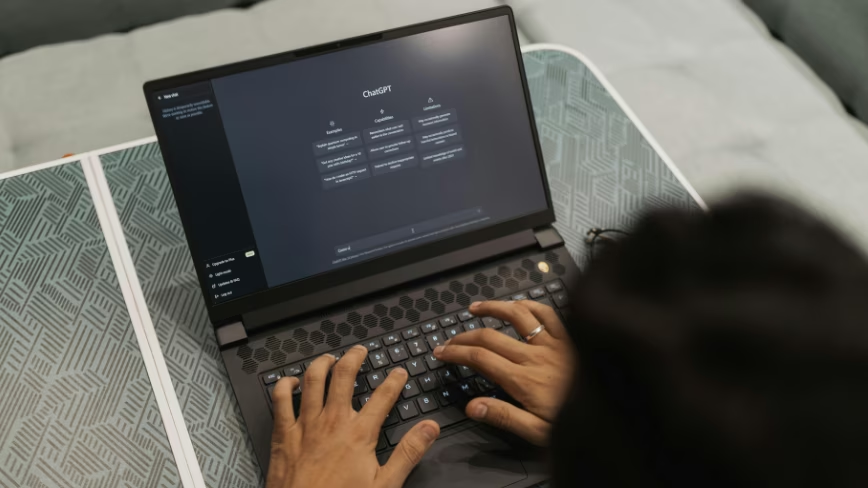
Nearly half of adults would publish AI-generated work without disclosing it, even though a majority believe other people should disclose it. That contradiction is at the center of a new international survey by Use.AI, an AI aggregation platform that asked 7,200 adults in the United States, Europe, the United Kingdom, and Latin America about their attitudes toward AI authorship. The results, released on July 30, show a workplace culture caught between growing reliance on generative tools and lingering stigma around admitting their use.
A split between personal behavior and public expectation
Forty-six percent of respondents said they would not reveal that AI played a role in work presented under their own name. Yet 54 percent said other people should disclose when they use AI for equivalent tasks. The gap between what people expect of others and what they practise themselves mirrors a pattern researchers have been documenting for months. People appear to believe that AI disclosure is a social norm, but not necessarily a personal obligation.
This asymmetry is not unusual in moral psychology. People often judge their own behavior more favorably than the behavior of others. But in the workplace, the consequences of this asymmetry are becoming more visible. Managers may be making decisions about promotions, productivity, and trust based on assumptions that do not match what employees are actually doing with AI.
When does AI output become your own?
The survey also explored when people feel entitled to call AI output their own. Sixty-nine percent said the work belongs to them if they supplied the instructions and approved the final version. Seventy-four percent felt the same after revising AI-generated material. Seventy-one percent said taking responsibility for accuracy was enough to claim authorship. These numbers suggest that many workers see themselves as editors or directors of AI rather than passive recipients of machine-generated text.
The definition of authorship is changing rapidly. In traditional publishing, authorship rests on human creative control. With generative AI, the human role can range from a single prompt to extensive rewriting and fact-checking. The survey results suggest that workers are drawing the line at meaningful human intervention, but that line is not always visible to colleagues or managers.
Use.AI sells a platform that aggregates multiple AI models into a single interface, which means the company has a commercial interest in normalising AI use. Its Managing Director, Ihor Herasymov, framed the findings as evidence that people already see themselves as authors when they guide AI. But the survey’s methodology, including its sampling method and margin of error, was not disclosed in the accompanying press release. That gap makes it difficult to assess how representative the results truly are.
Why workers go quiet about AI
Other research points in the same direction. Atlassian found that workers who disclose AI use are judged ten times lazier by colleagues, a finding that helps explain why many choose to stay quiet. A Harvard Business Review analysis published in June concluded that employees hide AI usage largely because they fear professional consequences, not because they lack awareness of disclosure norms.
The fear is not irrational. In a knowledge economy where productivity is often measured by output, admitting that a machine wrote the first draft can feel like admitting that one’s own skill is secondary. Even when companies encourage AI adoption, individual workers may hesitate to write “with AI” on a report if their teammates are not doing the same. The psychology of disclosure is shaped by signals from leadership, performance reviews, and peer behavior.
A separate ResumeBuilder survey found that nearly 63 percent of workers have never told their managers that AI was doing part of their job. Half of Gen Z workers report feeling guilty about using AI, even as employers increasingly rank AI skills above a university degree. The disconnect between private behaviour and public expectation is consistent across age groups and geographies.
Younger workers face a peculiar tension. They have grown up with digital tools and often feel comfortable using AI in their personal lives. At work, however, they worry about being seen as dependent on automation. The guilt reported by Gen Z suggests that even the most AI-native generation has internalized stigma rather than embracing the technology openly.
The ownership question and the law
The survey’s ownership findings raise legal questions that are still unresolved. The U.S. Copyright Office has said that works generated entirely by AI without human involvement are not eligible for copyright protection. However, when a human selects, arranges, or modifies AI-generated material, the resulting work may be protectable. The boundaries of this principle are being tested in courts and in copyright registrations.
The European Union is moving in a different direction. The EU’s AI Act transparency rules took effect on August 2, requiring companies to label AI-generated content that could pass for authentic, with fines reaching three percent of global turnover for non-compliance. The regulation targets deepfakes and synthetic media rather than workplace documents, but it signals a broader regulatory push toward mandatory disclosure that may eventually reach professional settings.
In the absence of clear legal standards for workplace AI, employers are left to design their own rules. Some companies have issued detailed AI policies that distinguish between permitted assistance and prohibited delegation. Others have said little, leaving employees to guess what is acceptable. The survey results show the danger of that approach: when norms are unclear, people tend to rely on their own judgment, and their judgment is often shaped by self-interest.
The pressure on workplace norms
Workplace norms around AI are not fixed. They are being negotiated in real time, through emails, Slack messages, performance reviews, and hallway conversations. Employees who openly discuss their AI use may be seen as forward-thinking by some and as lazy by others. Managers who want to encourage honesty may need to create safe ways for employees to admit they use AI, without immediately penalizing them.
Transparency is not just an ethical question. It is also an operational one. If a large share of employees are hiding AI use, then managers do not actually know how their teams are producing work. That makes it difficult to evaluate skills, plan training, and manage quality. Organizations that ignore the gap between belief and behavior may find themselves making decisions based on false assumptions about their workforce.
The timing of the survey is notable. AI tools became widely available to consumers in late 2022, and adoption in the workplace has accelerated since then. Many organizations initially reacted by banning AI tools altogether, fearing data leaks and errors. Over time, some of those bans were lifted as companies realized that employees were using personal accounts anyway. The result is a patchwork of policies that vary by industry, company size, and even team.
Signals from research on AI disclosure
Research on AI disclosure has consistently found a gap between what people say and what they do. Studies on algorithmic transparency show that users often want to know when they are interacting with a machine, but they rarely want to admit when they have used a machine themselves. This is similar to the distinction between “information sharing” and “confession” in social psychology.
The stakes are high. In professions such as journalism, law, and medicine, failure to disclose the use of AI could undermine public trust. A journalist who uses AI to draft an article may not break a law, but readers may feel misled if they learn about it later. A lawyer who uses AI to research a case may be expected to verify every source. Regulators are beginning to pay attention to these issues, and professional bodies are updating their ethics guidelines.
The survey does not resolve the question of whether disclosure should be required in every case. It measures attitudes, not policies. But the data make clear that a significant portion of the workforce has already crossed the threshold of using AI behind the scenes. If organizations want to build trust with clients, customers, and employees, they will need to address the contradiction between private behavior and public expectation.
For now, the gap between belief and behavior remains wide. People overwhelmingly think AI use should be disclosed, just not by them, and workplaces have yet to produce rules clear enough to close the distance. The tension is likely to increase as AI tools become more integrated into everyday work, from email drafting to code generation to slide design.
The next wave of workplace tools will make AI even harder to detect, not easier. Some systems will generate entire documents from a short outline. Others will rewrite an employee’s rough notes into polished prose. As these capabilities spread, the question of disclosure will become less about avoiding detection and more about defining what it means to author a piece of work.
Organizations that begin having honest conversations about AI use now may be better positioned than those that wait for a scandal or a lawsuit. The survey suggests that employees are ready to adopt AI and even to claim authorship of AI-assisted output, but they are not ready to face the judgment of their colleagues and supervisors. Closing that gap will require more than rules. It will require a change in culture.