

Key Facts
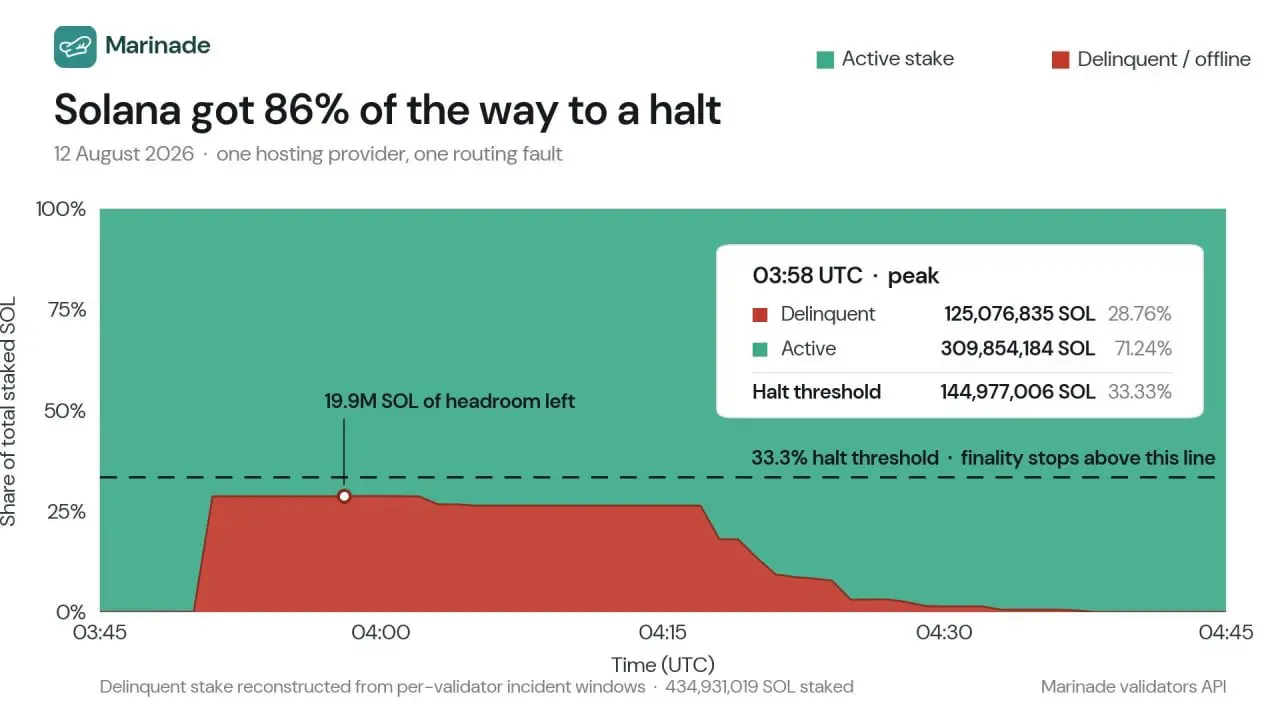
- A routing failure at a major data center provider briefly knocked nearly 29% of Solana's staked tokens offline, bringing the network close to a full halt, according to staking platform Marinade.
- Solana stops finalizing transactions if more than one-third of staked tokens go offline. The incident left the network within roughly 20 million SOL of that threshold.
- The glitch was traced to a bad internet route from Teraswitch's Miami facility that spread to data centers in Europe and Asia.
- The Solana Foundation said blocks and transactions never stopped, but the event exposed concentration risk in the network's validator infrastructure.
Close Call for Solana
Solana came dangerously close to a network-wide freeze Wednesday after a routing glitch knocked a significant portion of its staked tokens offline, according to Marinade, a leading liquid staking platform on the chain. The failure, which originated at Teraswitch's Miami data center and cascaded to other locations, briefly disconnected validators responsible for nearly 29% of the total amount of SOL staked to secure the network.
Solana's consensus design does not require every validator to be online at all times, but it does need a supermajority of staked tokens to participate for finality. If more than one-third of the staked supply becomes unreachable, the network cannot gather enough votes to finalize new blocks. That is the line Marinade says the network approached. According to its analysis, Solana was about 20 million SOL away from that threshold, a narrow margin in a network where tens of billions of dollars in assets depend on continuous operation.
The Solana Foundation, which oversees ecosystem development but does not control the network, offered a different emphasis. Foundation executives acknowledged the connectivity issue but stressed that blocks were still produced and transactions still settled throughout the incident. They did not deny that a large share of staked tokens had been offline, but pushed back on the idea that the network was on the verge of freezing.
The discrepancy between those two descriptions matters for Solana users and investors. A full freeze can damage confidence in a blockchain, especially after Solana's five-hour outage in February 2024. That earlier incident was caused by a combination of network congestion and a flaw in the transaction scheduling path, and it forced validators to coordinate a manual restart. Wednesday's event was different on the surface, but both episodes underscore the fragility of even the most active high-performance blockchains when infrastructure outside the core protocol fails.
Routing glitches are a familiar problem in internet infrastructure. BGP, or Border Gateway Protocol, is the postal system of the internet. It tells routers how to reach other networks by passing along routes from one autonomous system to another. When an operator announces an incorrect route, traffic can loop, vanish, or arrive at the wrong destination. In blockchain terms, validators can appear to be offline even if their servers are running normally because the network path between them and their peers has broken.
That appears to be what happened on Wednesday. A bad route originating in Teraswitch's Miami facility propagated to data centers in Europe and Asia, affecting a large number of Solana validators that rely on Teraswitch for connectivity. Because those validators collectively controlled more than a quarter of all staked tokens, the network's margin for finality shrank dramatically in a short period.
The incident raises hard questions about concentration in the validator ecosystem. Solana's high-performance design encourages validators to deploy in professionally managed data centers with powerful hardware and low-latency connections. That creates an economic incentive to concentrate infrastructure in a handful of locations. But it also creates a single point of failure. If one hosting provider, one cloud region, or one network carrier experiences an outage, the chain can be affected at scale.
Marinade's warning is notable because the platform is deeply embedded in Solana's staking ecosystem. Marinade lets SOL holders deposit tokens in exchange for mSOL, a liquid staking derivative, and it routes stake to validators based on performance and reliability. As a result, Marinade has a real-time view of validator health and staking behavior. Its assessment of the Wednesday incident should not be dismissed as noise.
At the same time, the Solana Foundation's response reflects a desire to keep the network's reputation intact. In public communications, Foundation representatives stressed that the network did not go offline and that transactions were not lost. That is true. A network can be within 20 million tokens of a freeze and still function normally. But held up under stress is a different claim from was never near the threshold. The two statements can both be accurate without telling the same story.
For Solana, the incident is also a reminder that resilience is not just about protocol design. The network has invested heavily in features like QUIC, a modern transport protocol, and stake-weighted quality of service to protect against spam and improve performance. But no protocol-level feature can prevent a cascading BGP failure from disconnecting a large set of validators. The health of the network depends on decisions made by validators, data center providers, and network operators.
One potential response is better diversification. Validators could spread infrastructure across multiple providers and regions, reducing the risk that a single routing failure takes out a quarter of staked tokens. Another is improved monitoring and alerting, so that when a route failure begins, the community can quickly see which validators are offline and why. A third is more robust failover systems, allowing validators to switch to backup connections without missing voting slots.
None of these fixes are simple. Solana validators face intense pressure to be fast, and redundant connections can add latency or increase costs. But Wednesday's near-miss suggests that ignoring concentration risk is itself a kind of risk. The network has grown into one of the largest ecosystems in crypto, with a wide range of DeFi protocols, NFT markets, and consumer products. A freeze at this stage would have serious consequences, not just for SOL's price but for the credibility of the entire network.
The event also has implications for staking participants. Many SOL holders stake through liquid staking services like Marinade, or through exchanges that run validators. They may not know which data center their stake is connected to. If a single provider controls a large fraction of the validator set, individual users have little ability to reduce systemic risk without staking infrastructure becoming more decentralized.
Solana's community has debated validator decentralization for years. The network has a much smaller validator set than Ethereum, and the hardware requirements for running a Solana validator are high. That limits the pool of people who can participate. Single-leader block production, combined with aggressive entry timing, rewards validators that are physically close to other validators and to the network's quorum. This has led to well-known clustering patterns in places like Northern Virginia, where cloud providers and data centers host many of the network's most active participants.
Teraswitch is not the only provider with significant Solana concentration. The broader issue is that when validators chase speed, they end up in the same buildings or on the same networks. The February 2024 outage and Wednesday's routing event are both symptoms of that underlying structural tension. A blockchain can have an elegant consensus algorithm and still be fragile if the physical and network infrastructure beneath it is concentrated.
The good news for Solana is that the network did not stop. Blocks were minted, transactions were confirmed, and once the route was corrected, validator participation likely returned to normal. But the incident is a warning. The threshold for a freeze is not theoretical; it is a hard line defined by the network's protocol. Coming within 20 million SOL of that line was not a normal occurrence. It was a reminder that in crypto, infrastructure risk is consensus risk.
In the days ahead, more data will likely emerge about exactly which validators were affected and how quickly the network recovered. Marinade's monitoring tools will continue to track validator participation, and the Solana Foundation will try to reassure users that the chain remains robust. Those two perspectives will continue to shape the narrative around the event. For now, the most useful takeaway is simple: Solana came close to a freeze, and the only thing standing between the network and a major outage was a margin that was far thinner than anyone should be comfortable with.
Source: Coindesk News