

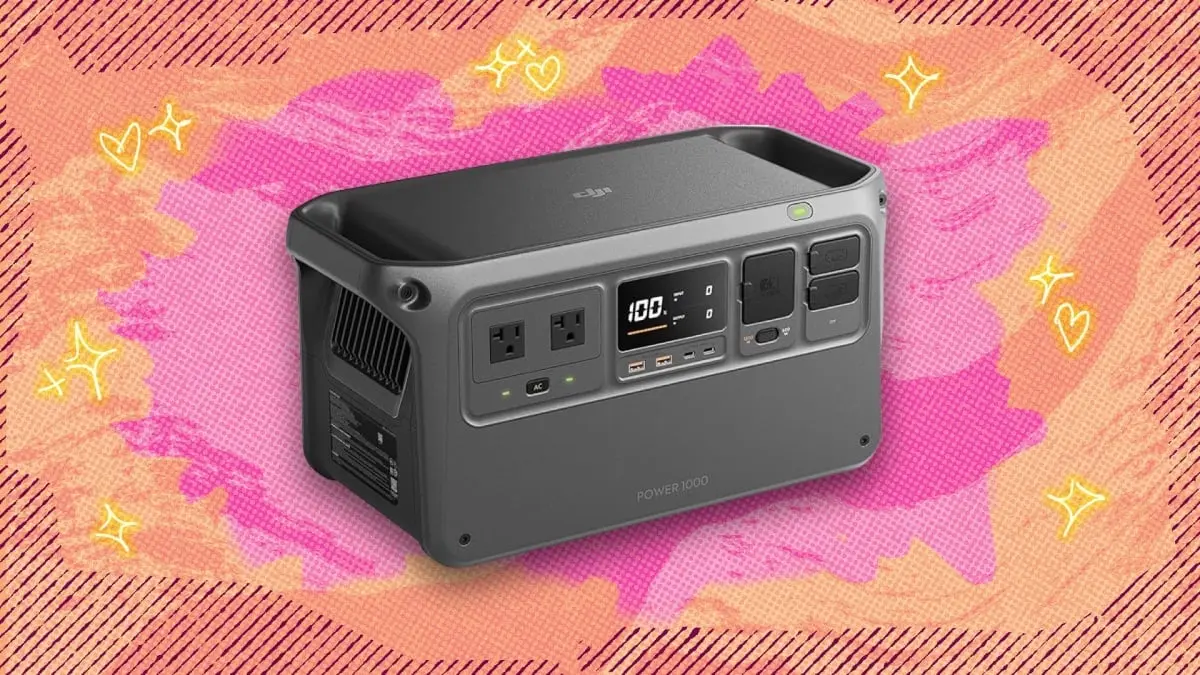
Deal Alert: DJI Power 1000 Drops to Record Low Price
As of July 27, the DJI Power 1000 Portable Power Station is available at Amazon for $348.98 — a massive 50% discount off its $699 list price. That’s a savings of $350, making this one of the best deals we’ve seen on a high-capacity portable power station this year. The price drop comes just in time for summer outdoor adventures and storm season preparedness, offering a rare opportunity to pick up a premium backup power solution at a significantly reduced cost.
Key Facts at a Glance
- Current Price: $348.98 (was $699) — save $350.02
- Power Output: 2,200W continuous (4,400W peak) — enough for power tools, camping gear, and appliances
- Battery Capacity: 1,024Wh (1024 watt-hours)
- Battery Chemistry: LFP (Lithium Iron Phosphate) — rated for approximately 4,000 charge cycles
- Recharge Time: ~70 minutes via wall outlet; ~1.35 hours via solar (max input)
- Noise Level: 23 decibels while charging — quieter than a refrigerator
- Safety Certifications: 26 separate certifications passed; built-in battery management system (BMS)
- Warranty: 5-year warranty included
- Where to Buy: Amazon — deal subject to change
Why This Deal Matters
Portable power stations in the 1,000Wh range rarely see discounts of this magnitude. Most competitors like Jackery, EcoFlow, and Goal Zero typically offer 20-30% off during sales events, but a full 50% reduction is exceptional. The DJI Power 1000 originally launched at $699, and this price point undercuts many similarly specified models while adding the reliability of a brand known for drones and camera gimbals. DJI’s entry into the power station market has been well-received, and this deal makes it accessible to a wider audience, from casual campers to off-grid workers.
In-Depth Feature Analysis
Power and Capacity
The DJI Power 1000 delivers 2,200W continuous power from its 1,024Wh battery. This is sufficient to run most household and outdoor electronics: a mini-fridge, a 50-inch TV, a desktop computer, or even a small portable air conditioner. The peak surge capability of 4,400W ensures it can handle the startup draw of motor-powered tools like drills or circular saws. For comparison, a standard Jackery Explorer 1000 offers 1,000W continuous, while EcoFlow’s Delta 2 provides 1,800W — the DJI unit sits above both in output, though the Delta 2 has a slightly larger 1,024Wh capacity too. The inverter technology in the DJI Power 1000 is efficient, with a pure sine wave output that protects sensitive electronics from power surges or fluctuations.
Battery Technology: LFP Longevity
The use of LFP (Lithium Iron Phosphate) chemistry is a standout feature. Unlike traditional lithium-ion batteries found in older power stations, LFP batteries are far more durable. They can withstand roughly 4,000 charge cycles before reaching 80% of original capacity. If you use the power station once a week, that translates to over 76 years of use — though in reality, daily use could still give you a decade of reliable service. This makes the DJI Power 1000 a long-term investment, especially when compared to cheaper units with NMC (Nickel Manganese Cobalt) batteries that typically last only 500-1,000 cycles. LFP batteries are also safer, with lower risk of thermal runaway, and they perform better in extreme temperatures, maintaining capacity in both hot and cold environments.
Charging Speed
One of the most praised aspects of the DJI Power 1000 is its fast recharge rate. From a standard wall outlet, the unit can go from empty to full in about 70 minutes — that’s roughly 880 watts of input. This is possible thanks to an advanced charging controller and a high-power AC adapter. For off-grid scenarios, the solar charging capability is equally impressive: with maximum solar input (supporting up to 600W panels), the power station can be fully charged in approximately 1.35 hours. This is faster than many competitors, which often take 3-5 hours on solar due to lower input limits. The built-in MPPT (Maximum Power Point Tracking) charge controller optimizes the energy drawn from solar panels, ensuring maximum efficiency even in partly cloudy conditions.
Noise and Portability
At 23 decibels, the DJI Power 1000 is remarkably quiet while charging. To put that in context, a library is around 40 dB, a typical conversation is 60 dB, and a refrigerator hums at about 50 dB. The low noise is achieved through a combination of passive cooling and a low-speed fan that only activates under heavy load. When not charging, the unit operates silently, making it ideal for use in tents, RVs, or indoor spaces where noise could be disruptive. The power station itself weighs approximately 30 pounds (13.6 kg) and features a compact design with a handle, making it portable enough to carry from the car to a campsite or from a storage closet to a living room during a storm.
Safety and Reliability
DJI has equipped the Power 1000 with a comprehensive Battery Management System (BMS) that monitors voltage, current, temperature, and individual cell balance. It protects against overcharging, over-discharging, short circuits, and overheating. Additionally, the unit has passed 26 safety certifications, including UL standards, which are crucial for peace of mind when using high-capacity lithium batteries indoors. The five-year warranty is longer than the industry standard, which typically ranges from two to three years. This extended coverage reflects DJI’s confidence in the product’s durability and provides an extra safety net for buyers.
Market Context and Competitor Comparison
The portable power station market has exploded in recent years, driven by the growth of remote work, van life, and climate-related power outages. Leading brands like Jackery, EcoFlow, Anker, and Goal Zero offer similar products, but the DJI Power 1000 stands out for its high continuous output and fast charging. The EcoFlow Delta 2 (1,024Wh) typically sells for $599-$699, while the Jackery Explorer 1000 (1,002Wh) is often priced around $599. At $348.98, the DJI model undercuts both by a significant margin, even after typical discounts. The closest competitor in terms of price is often the refurbished or open-box units, but those lack the full warranty. This deal essentially gives you a premium product at a budget price point.
Another consideration is the solar panel compatibility. DJI offers its own 120W solar panels (sold separately), but the Power 1000 can also work with third-party panels as long as they support the standard MC4 connectors and voltage range. The MPPT controller automatically adjusts to maximize input, providing flexibility for users who already own solar panels from other brands.
Practical Use Cases
Camping and Outdoor Recreation
Summer camping trips often require running a portable refrigerator, charging phones and laptops, powering lights, and inflating air mattresses. The DJI Power 1000 can handle all these tasks simultaneously, thanks to its 2,200W output and multiple ports, including three AC outlets (standard three-prong), two USB-A, two USB-C (max 140W for fast charging laptops), and a 12V car port. The USB-C ports support Power Delivery (PD) and can quickly charge a MacBook Pro or a modern smartphone. The unit also has a backup UPS mode: when plugged into a wall outlet, it passes through power to connected devices while keeping the battery fully charged, and if the grid fails, it switches to battery power in under 20 milliseconds — fast enough to keep a desktop computer or router running without interruption.
Emergency Backup for Home
For those living in areas prone to hurricanes, winter storms, or rolling blackouts, having a portable power station can be a lifesaver. The DJI Power 1000 can power a refrigerator for several hours (depending on the fridge’s energy consumption), charge medical devices, keep phones and radios operational, and run a small space heater or fan. Its quiet operation is a major advantage over gas generators, which are noisy, produce fumes, and require fuel storage. The LFP battery’s long cycle life also means the station can sit on a shelf for months with minimal self-discharge (around 3% per month), ready to be deployed when needed.
Worksites and DIY Projects
Contractors, woodworkers, and hobbyists often need portable power for tools in locations without grid access. The DJI Power 1000 can run circular saws, miter saws, drills, and impact drivers provided their starting current doesn’t exceed the 4,400W peak. It can also power small air compressors and paint sprayers. The fast recharge time means you can run tools for a period, then quickly top up the battery during a lunch break. For construction sites, the rugged build and safety features add resilience against dust and minor impacts.
Expanded Background on DJI’s Power Station Venture
DJI, best known for its market-leading drones (such as the Mavic series and Phantom series) and camera stabilization systems (Ronin gimbals), entered the portable power station market in 2023 with the launch of the Power 1000 and the larger Power 2000 (2,048Wh). The company leveraged its expertise in battery management and power electronics from years of developing reliable flight batteries for drones. The Power 1000 is built around the same cell technology used in some of DJI’s high-end drone batteries, which gives it confidence in safety and longevity. The product targets both existing DJI customers who want a unified ecosystem (e.g., using the same solar panels for drone charging) and new users seeking a high-quality power station. Despite being a relatively new player in the battery backup market, DJI has already earned positive reviews for build quality and performance, though its availability is still more limited than that of established rivals. This Amazon deal expands its reach significantly.
Tips for Maximizing the DJI Power 1000
To get the most out of your power station, consider the following:
- Solar Panel Pairing: For optimal solar charging, use panels rated for at least 400W total input (e.g., two 200W panels in series). DJI’s own 120W folding panels are compact and easy to carry, but third-party options can be more cost-effective.
- Battery Care: LFP batteries prefer to be kept between 20% and 80% charge for daily use, though full cycles are also fine. The BMS handles automatic balancing, but avoiding extreme temperatures (below 14°F or above 113°F) will extend lifespan.
- Load Management: If you need to run high-draw devices like a microwave (typically 1,000-1,500W), check the power station’s continuous rating. The DJI Power 1000 can handle most microwaves up to 1,200W, but avoid running multiple heavy loads at once.
- Transportation: The unit can be carried by its handle, but it’s relatively heavy. For air travel, check airline regulations — most airlines allow batteries under 160Wh in carry-on, but the 1,024Wh exceeds that limit, so it must be shipped or driven.
- Firmware Updates: DJI occasionally releases firmware updates via its app that can improve charging algorithms and add new features. Connect to the app (available for iOS and Android) to check for updates.
The DJI Power 1000 also features a built-in LED light with a flashlight mode and a strobe mode for emergencies, which is a thoughtful addition not found on many competitors. The app allows remote monitoring of battery level, input/output watts, and estimated runtime, as well as control over individual AC outlets and the USB ports.
Final Thoughts on the Deal
This price cut to $348.98 represents an exceptional value for a 1,024Wh portable power station with LFP battery, 2,200W inverter, and fast charging. Whether you’re preparing for hurricane season, planning a cross-country road trip, or just want a reliable backup for your home office, the DJI Power 1000 delivers performance that matches or exceeds products priced $200-300 higher. The deal is live now at Amazon, but as noted, pricing and availability can change at any time. Given the record-low price and the high demand for power stations during summer, it may not last long. If you’ve been waiting for a sign to invest in portable power, this is it.
Source: Mashable News