

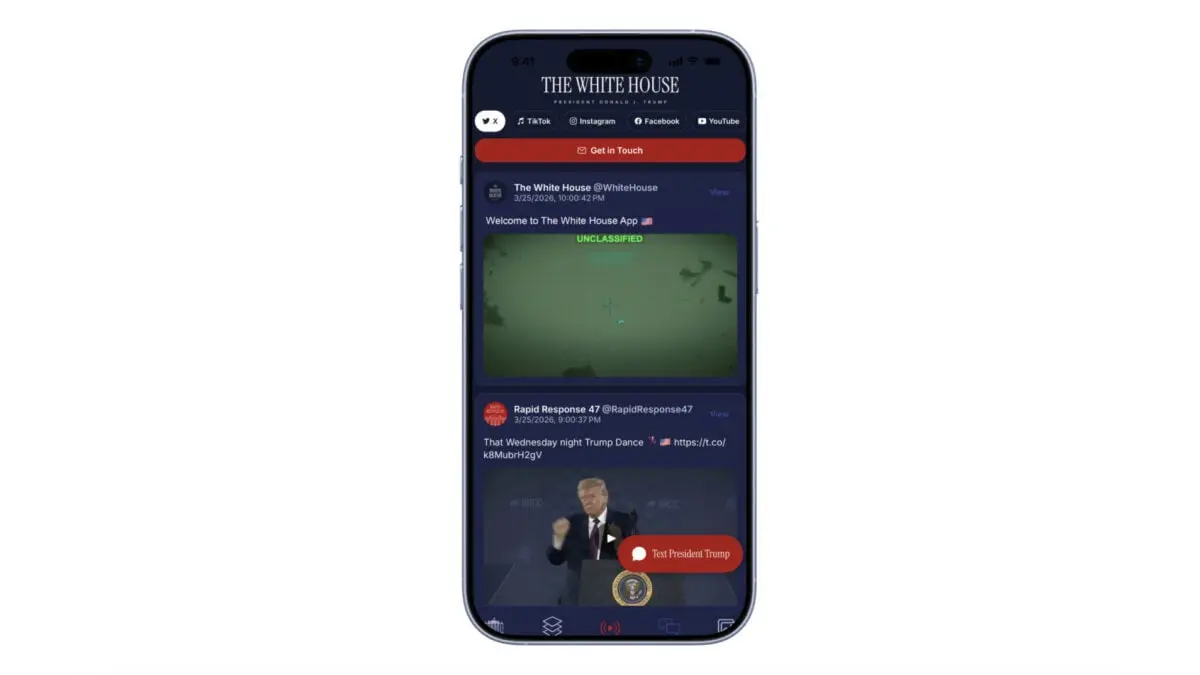
The White House has announced plans to automatically install its official mobile application on all Department of Homeland Security (DHS) devices, a move that has sparked significant debate over cybersecurity and data privacy. The app, which was originally released in March 2026 on the App Store and Google Play, provides what the White House describes as "unfiltered, real-time updates straight from the source"—the source being President Donald Trump. According to an internal email obtained by Politico, DHS employees received notification on Tuesday that the app will be auto-loaded onto their work phones, much like the controversial U2 album that automatically downloaded to iPhones in 2014, but with far more serious implications.
App Features and Data Concerns
The White House press release lists several key features of the app, including breaking news alerts on major announcements, executive actions, and other key priorities. The app also offers video streaming of White House events, a library of archived Trump sound bites, and the ability to "stay connected" with new policies. Users can send feedback, including via voice recordings. However, it is the app's data collection practices that have drawn the most scrutiny. According to a report from Notus.org, the app collects user data such as time zone, IP address, device identifiers, and usage patterns, and shares this information with third parties. Notus notes that the app "doesn't disclose its data sharing the way most others do," raising concerns about transparency and compliance with federal privacy standards.
Government Mandate and Security Risks
Last month, the Trump Administration instructed federal agencies to begin installing the app on government-issued phones, with the Federal Aviation Administration (FAA) becoming the first agency slated for auto-downloads. The push has alarmed cybersecurity experts, including Sonny Hashmi, a former IT executive for the General Services Administration. Hashmi told Government Executive that auto-installing the app is "cause for alarm" because "any app that is installed on government issued devices can potentially create backdoor access to government networks behind the firewall." This concern is amplified by the fact that DHS devices often handle sensitive information related to national security, border control, and emergency response. If the app contains vulnerabilities or malicious code, it could serve as a vector for espionage or data exfiltration.
Historical Context and Comparison
This is not the first time the White House has released a mobile app. In 2010, during the Obama administration, a similar app was launched to provide access to presidential updates, photos, and videos. That app, while not without its own flaws, did not mandate installation on government devices. The Obama-era app was criticized for being buggy but did not generate the same level of concern over data sharing and security. The current app's aggressive deployment strategy—particularly the auto-installation without user consent—represents a significant departure from previous practices. It also raises legal questions about whether such a mandate violates employees' rights to control their devices, especially given the potential for personal data being shared with third parties.
Broader Implications for Federal Cybersecurity
The decision to auto-load the White House app onto DHS devices comes at a time when federal cybersecurity is under intense scrutiny. Government networks have been targets of sophisticated cyberattacks from state actors and criminal groups. The SolarWinds breach of 2020 and the Colonial Pipeline attack in 2021 highlighted the vulnerabilities of critical infrastructure. In this context, any software forced onto government devices is subject to rigorous vetting. Critics argue that the White House app has not undergone such scrutiny. The app's developer, likely a private contractor, may not have implemented the highest security standards. Furthermore, the collection of data like IP addresses and time zones could be exploited to track the movements and activities of DHS employees, posing risks to both personal privacy and operational security.
Political and Legal Reactions
The auto-installation has drawn mixed reactions from lawmakers and privacy advocates. Some Republican supporters of the Trump administration view the app as a useful tool for direct communication, while Democrats and civil liberties groups have expressed concerns about potential misuse of personal data. The American Civil Liberties Union (ACLU) has not yet commented on this specific development, but similar initiatives in the past have led to lawsuits over unconstitutional surveillance. The Electronic Privacy Information Center (EPIC) has previously criticized the administration's approach to data collection. Legal experts suggest that if the app shares location data or other sensitive information with third parties without explicit consent, it could violate the Privacy Act of 1974, which governs how federal agencies handle personal information.
Technical Details and User Experience
The app is reportedly built on a standard framework that supports iOS and Android devices. Users who already have the app installed will not experience any changes, but those who do not will see it appear on their home screen after the next mandatory update. DHS employees reportedly received an email with instructions on how to use the app, though opting out is not clearly explained. The email says the app is "a convenient way to access official White House communications, including announcements, executive actions, speeches, livestreams, videos and other updates." However, the lack of an opt-out mechanism has angered some employees, who feel that their personal device usage is being co-opted for political messaging. The auto-install also consumes storage space and may run background processes that drain battery life and data allowances.
Comparison to Similar Mandates in Other Countries
Mandating a government app on official devices is not unprecedented. In some countries, such as China, government employees are required to use specific apps for official communications. However, in democratic nations, such mandates are rare and often legally contested. The United Kingdom, for instance, requires certain health and safety apps on work devices but allows exemptions. The United States has previously required some apps for travel or security purposes, but the White House app is unique in that it serves a purely political and informational role. This distinction may affect how courts view any legal challenges, as free speech and association rights could be invoked if employees are compelled to install a political tool on their devices.
Future Outlook
As the auto-installation rolls out across DHS and potentially other federal agencies, the debate over its security and privacy implications will likely intensify. The Trump administration has defended the app as a transparent means of communication, but cybersecurity experts remain skeptical. The controversy also highlights the broader tension between modernization of government communications and the need to protect sensitive networks. With the midterm elections approaching, the app could become a partisan issue, with Democrats criticizing it as an attempt to politicize federal agencies. Regardless of the outcome, this move sets a precedent for how future administrations may use mobile technology to engage directly with government employees and the public, potentially reshaping the landscape of digital governance.
Source: Gizmodo News