

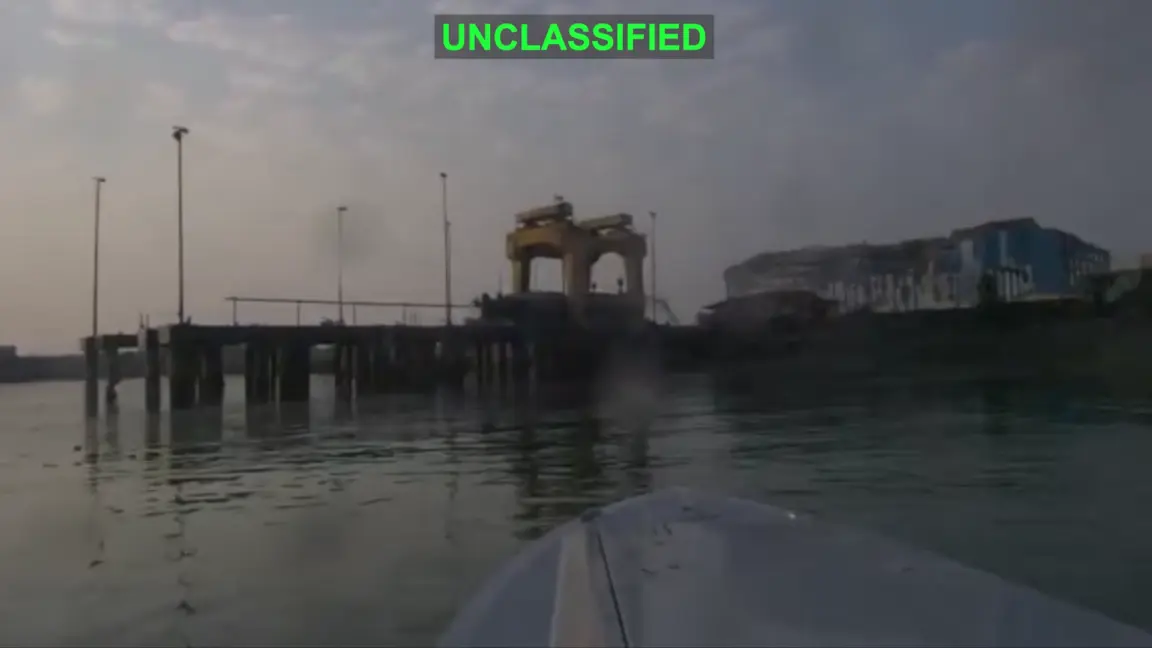
For the first time in its history, the US military has used explosive-laden drone boats in combat, striking an Iranian midget submarine and a naval port at Bandar Abbas Naval Base. The operation took place on the night of July 12 and was documented in a video released by US Central Command. The footage showed three one-way attack surface drones approaching their targets and detonating. US Central Command described the strikes as the first time American forces have employed sea drones in combat operations.
The US drone boats were able to make a low-speed, uncontested approach before exploding, according to naval reports. One target was identified as an Iranian Ghadir-class midget submarine that was out of the water and suspended from a gantry. The other target appeared to be a ship maintenance facility. The attack was part of a broader wave of strikes by US fighter aircraft and warships against Iranian targets in recent days.
The technology behind the strikes involved Saronic Corsair autonomous surface vessels developed by Saronic Technologies, a defense company based in Austin, Texas. The company describes the drone boat as being 24 feet in length and capable of carrying up to 1,000 pounds over 1,000 nautical miles at a top speed exceeding 34 knots. The Corsair is designed to operate autonomously without direct human control. That includes long-range navigation, patrol missions, regulating power consumption and engine use to loiter at a specific position. The boats are built for a wide variety of missions and were likely equipped with explosives for this specific strike.
This was not the first notable use of a Corsair sea drone by the US military during the current war. On June 8, a Corsair drone boat rescued two US Army helicopter pilots in the waters off the coast of Oman after their AH-64 Apache helicopter was shot down by an Iranian Shahed drone. That rescue mission highlighted the versatility of the platform beyond offensive strikes. The war with Iran began with US and Israeli attacks on February 28, 2026, and the conflict has since seen a wide range of drone warfare on both sides.
How drone boats became a battlefield weapon
The United States is far from the first country or faction to use exploding drone boats, often described colloquially as kamikaze or suicide drone boats. The first confirmed use of such weapons occurred on January 30, 2017, when the Houthi faction based in Yemen struck the Royal Saudi Naval frigate Al Madinah using an uncrewed remote-controlled boat. A US Navy commander said at the time that the Houthi weapon was likely developed with technical assistance from Iran, which has long supported the Houthis.
Since then, drone boats have become an increasingly important tool in asymmetric warfare at sea. The Ukrainian military has developed and deployed a variety of explosive drone boats since Russia launched its full-scale invasion of Ukraine in February 2022. Despite lacking a traditional navy, Ukraine has used a combination of flying drones and explosive drone boats to strike Russian warships, tankers and port infrastructure. These attacks forced Russia to withdraw its Black Sea Fleet to bases farther from Ukraine and disrupted vital Russian shipping routes.
Ukrainian drone boats have also achieved several milestones in military history. They have used missiles to shoot down Russian helicopters and acted as surface platforms to deploy small flying drones to strike Russian air defenses. Most recently, a Ukrainian drone boat deployed an armed ground robot onto contested coastal territory in an unprecedented amphibious operation. These innovations have demonstrated that relatively inexpensive uncrewed surface vessels can pose a serious threat to conventional naval forces.
The Houthi attacks in the Red Sea and Gulf of Aden have further illustrated the value of drone boats. Houthi forces have launched a number of uncrewed surface vessels at commercial shipping and military targets, forcing naval coalitions to devote significant resources to countering them. The ability of non-state actors and smaller nations to field such weapons has pushed major militaries, including the US Navy, to accelerate their own uncrewed vessel programs.
A shifting US approach to drone warfare
Although the Corsair is relatively new to the fleet, the US Navy has experimented with a variety of uncrewed surface vessels for years. Programs such as the Sea Hunter and various prototype patrol boats have tested autonomous navigation, mine countermeasures and anti-submarine warfare capabilities. However, many of those programs were designed primarily for intelligence, surveillance and reconnaissance rather than direct attack. The July 12 strike represents a significant doctrinal change, moving uncrewed vessels from auxiliary support tools to active offensive combat platforms.
The US military's use of drone boats in combat marks a major shift in how the Pentagon views uncrewed systems. For years, the United States relied heavily on expensive, high-end drones such as the MQ-9 Reaper for surveillance and strike missions. The war against Iran has exposed the limits of that approach. The US military has lost dozens of Reaper drones collectively worth more than $1 billion during the conflict, many of them to relatively cheap Iranian Shahed drones and air defenses. That experience has driven a push to procure a new generation of cheaper surveillance and strike drones.
The US military has also been using one-way aerial attack drones for the first time during the war with Iran. Among them are LUCAS drones, which are based in large part on Iranian-developed Shahed drones. The Shahed design, originally fielded by Iran and later mass-produced in Russia for use against Ukraine, has become a symbol of low-cost drone warfare. By adapting similar designs, the United States is acknowledging that quantity and affordability can be just as important as cutting-edge technology.
The drone boat strikes at Bandar Abbas are another sign of that shift. Instead of relying solely on manned warships, submarines or aircraft to deliver explosive warheads near the Iranian coast, the US military fielded relatively small autonomous boats that could approach targets quietly and without putting American crew members at risk. The ability to operate such vessels in contested environments is likely to shape future naval planning.
The broader conflict with Iran remains fluid. President Donald Trump once again ramped up the war after the collapse of a supposed ceasefire, and US forces have continued to strike Iranian targets from the air and sea. The drone boat operation on July 12 was not an isolated event; it came alongside conventional strikes by US fighter aircraft and warships. Whether the US military will continue to employ sea drones in this way is unclear, but the precedent has been set.
The use of explosive drone boats by the United States also raises important questions about escalation, accountability and the future of naval combat. Autonomous and remote-controlled vessels are harder to detect than traditional patrol boats, and they can be deployed in swarms. They also lower the human cost of an attack for the side that launches them, which may make leaders more willing to use force. At the same time, the proliferation of such weapons means that even non-state actors can threaten powerful navies, a dynamic that has already been visible in the Red Sea and the Black Sea.
The US military's adoption of kamikaze drone boats comes nearly a decade after Iranian and Houthi forces first demonstrated such weapons. It also follows the Ukrainian military's successful use of similar vessels to challenge Russian naval dominance. For now, the Corsair drone boat has proven itself in both combat and rescue roles, and it is likely to remain a key part of the US Navy's expanding uncrewed fleet. The attacks at Bandar Abbas may be remembered not just as another battle in a long war, but as the moment the United States formally embraced a new class of naval warfare.
Source: Ars Technica News