

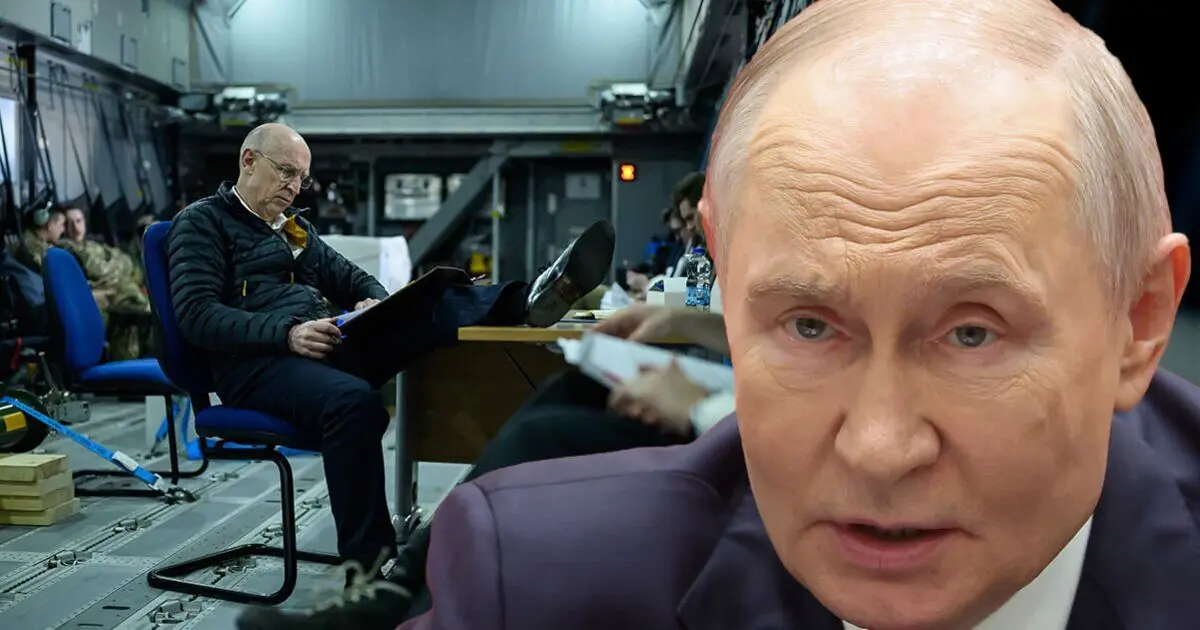
Last month, Defence Secretary John Healey stood in number 11 Downing Street and issued a direct message to Vladimir Putin. Standing before journalists as he revealed a month-long Royal Navy mission to track and deter Russian submarines, he told the Russian leader directly: “We see your activity over our cables and our pipelines, and you should know that any attempt to damage them will not be tolerated and will have serious consequences.”
Last week, Vladimir Putin sent a message back to Mr Healey, in the form of an electronic warfare attack on the defence secretary’s plane. The two interactions show the vastly different approaches towards the conflict boiling below the surface. Mr Healey used words, while Putin used actions. And, in the arena of global politics, as much as any other, actions speak louder than words.
This government talks a good game, but actions rarely follow suit. The RAF plane transporting the Defence Secretary had its GPS signals jammed and was forced to resort to backup methods of communication and navigation. The incident occurred near Russian territory, but the precise location remains classified. Electronic warfare has become a hallmark of Russian aggression in recent years, used extensively in Ukraine to disrupt drones, missiles, and command systems. This attack on a senior NATO official's aircraft marks a significant escalation in Russia's willingness to directly challenge British military capability.
In the broader context, Russia has been systematically testing NATO's defences through jamming, spoofing, and probing operations. In 2023, Russian aircraft repeatedly violated allied airspace near the Baltic states. Earlier this year, a Russian drone was found to have crossed into Polish airspace, while Moscow-backed vigilante groups have been implicated in attacks on British soil. The attack on the Defence Secretary's plane is therefore not an isolated incident but part of a pattern of increasingly brazen behaviour.
The issue, of course, is that years of underinvestment in defence and two years of dithering on spending by the Labour government have largely put actions out of the reach of decision makers grasping for an ability to counter Russia’s ever increasingly brazen attacks, incursions, and provocations.
The Defence Investment Plan is wildly behind schedule, and each passing month that the publication is delayed is more time that military planners spend with their arms tied behind their backs. Conversations with people inside the Ministry of Defence and the British Army would suggest that the delay lies not entirely with defence but with the Treasury, who have seemingly lost faith in the MOD’s ability to get maximum value for each taxpayer pound.
History would suggest those concerns are not without merit. The 2010 Strategic Defence and Security Review cut the Army to its smallest size in centuries. The 2015 review further reduced capabilities, especially in armoured warfare. The Integrated Review of 2021 promised a tilt to the Indo-Pacific but delivered little concrete spending. However, history would also suggest that to wait, dither, and delay while your adversaries arm and prepare is highly risky if not outright negligent. Russia has increased its defence budget to nearly 40% of national spending, devoting its entire economy towards war production. In contrast, the UK's defence budget remains at around 2.3% of GDP, with plans to reach 2.5% only by 2030 – a target many in the Atlantic Alliance now consider insufficient given the threats.
The fact of the matter is that while John Healey calls for more funding and Rachel Reeves drags her heels in pursuit of supporting the lie-ins of those work-shy in our society, one man could step in to drive Britain’s rearmament: Sir Keir Starmer. The Prime Minister has been conspicuously absent from the defence debate, preferring to delegate to cabinet ministers. Yet the electronic warfare attack on the Defence Secretary raises the stakes to the highest level. This is not a bureaucratic squabble over departmental budgets; it is a direct act of aggression against a senior British official. Starmer cannot afford to remain aloof.
It is well known that the Prime Minister does not care much for adjudicating on the inter-departmental squabbles of cabinet ministers. But in this case, what is the alternative? Another two years of incremental progress while Russia devotes its entire national effort towards war? The reality in geopolitics is that if you are not moving forward, you are going backwards. Under Starmer, this Government has hesitated at every moment to drive rearmament forwards to the extent where defence small and medium enterprises are looking abroad for business, such is the frustration with the lack of appetite in the UK market.
Britain's defence industrial base is in a precarious state. BAE Systems remains a global player, but smaller suppliers – the firms that innovate in sensors, software, and specialised components – are struggling. The government's persistent delays in awarding contracts for new drones, armoured vehicles, and electronic warfare systems have forced many to seek clients in the United States, Israel, South Korea, and even across Europe. The Treasury's insistence on a full value-for-money review before every major procurement decision has created a bureaucratic bottleneck that slows down everything from simple spare part orders to complex missile system upgrades.
The attack on the Defence Secretary's plane underscores the urgency of reversing this trend. GPS jamming is a tactic that can be countered with advanced inertial navigation and anti-jamming antenna arrays – technologies that British firms already produce. Yet the MoD has been slow to integrate them into the fleet, partly due to cost concerns and partly due to the fragmentation of procurement across different programmes. If the government wants to send a credible message to Putin, it must first ensure its own equipment is resilient. That requires investment now, not in three years' time.
War in the Middle East, Iranian-backed attacks on RAF bases, Russian drones in Poland and Estonia, Moscow-backed vigilantes launching attacks on the UK mainland. None of these has lit a spark under this government and forced them to speed up their action. You would like to think that a brazen and deliberate attack on the Defence Secretary would do so, but recent history suggests it won’t. The pattern is clear: each new provocation is met with a statement of concern, a diplomatic protest, and perhaps a modest increase in patrols. Rarely does it result in the kind of structural change that would actually deter further aggression.
To truly respond to Putin's message, Starmer must take three steps. First, he must personally chair a meeting of the National Security Council to set a clear timeline for the Defence Investment Plan, overriding Treasury objections if necessary. Second, he must order an immediate review of electronic warfare protection for all official government aircraft, with priority funding for upgrades. Third, he must signal to allies and adversaries alike that the UK is committed to spending at least 3% of GDP on defence by 2030, a figure supported by many NATO partners and former military chiefs. Anything less will be seen as weakness.
The Russian attack on John Healey's plane is a test of Britain's resolve. Putin is watching to see whether Labour will rise to the challenge or continue to flounder in inter-departmental indecision. The Prime Minister has the power to change course. The question is whether he has the will to use it before the next message comes in the form of an even more dangerous act of aggression.
Source: Express.co.uk News