
A new report from Politico makes fascinating, if somewhat amusing, reading right now. It sounds like Big AI wants the Trump Administration to speak in a clear voice about what’s not okay, and broadly thinks it was inevitable that it would eventually crack down like it has recently on Anthropic. But it also wants the old Trump Administration back—the one that said AI shouldn’t be regulated.
Dean Ball, recently hired at OpenAI to a position called “Head of Strategic Futures,” put it like this in Politico’s story:
“[T]here are things the administration is doing that I’m not so much of a fan of, in terms of the abruptness and the opacity and the strictness, but the more fundamental point is that I’m glad they’ve arrived to the conclusion that they have — to take this stuff seriously.”
When I was about nine and I was sitting down to have a tooth extracted, before my dentist even so much as put a bib on me, he held up his tray of tools. I remember an intimidatingly huge, all-metal syringe; a thick-walled pair of honest-to-god pliers with textured grips like you might see in a garage; and a puzzlingly large, flat, blunt thing that looks like a tow truck driver might use it to jimmy open a locked car. These objects were all about to be shoved into my mouth, and my dentist was wise to not want me to be surprised about it.
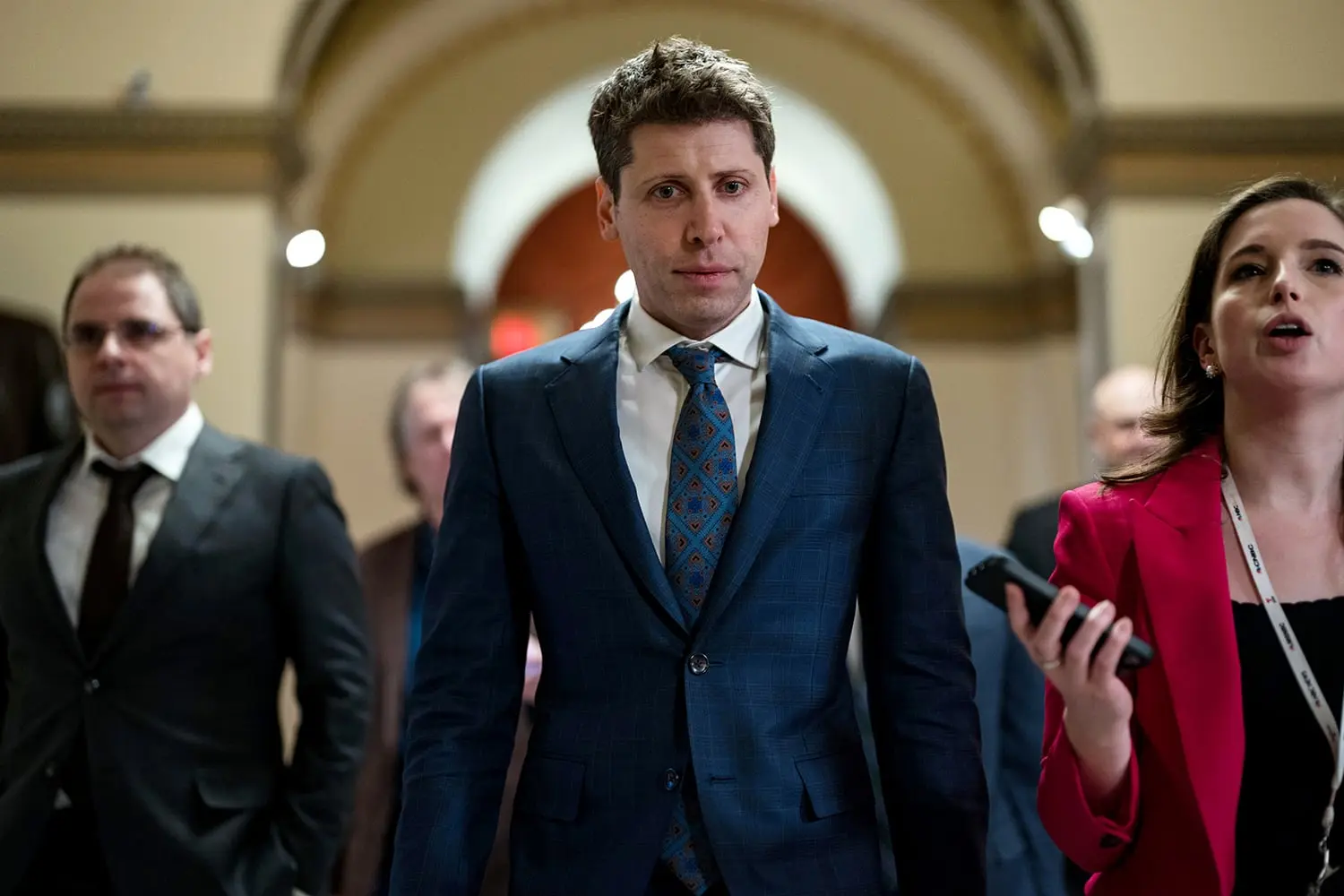
It was in a somewhat similar spirit that OpenAI CEO Sam Altman went before Congress in 2023 and said, “I think if this technology goes wrong, it can go quite wrong. And we want to be vocal about that,” adding, “We want to work with the government to prevent that from happening.”
In his essay “The Adolescence of Technology,” Dario Amodei wrote that humanity’s ability to pull through the turmoil about to be wrought by AI, “will depend on our character and our determination as a species, our spirit and our soul.” And added that, “The years in front of us will be impossibly hard, asking more of us than we think we can give.”
This is going to hurt, they seemed to be saying, and we don’t want to be the ones who get blamed if it does. Altman and Amodei might well have been disingenuous back when they were saying these things, but they were also right.
One crucial difference between Big AI and a dentist is that America has not actually asked Sam Altman or Dario Amodei to extract our metaphorical teeth. The dentists have arrived unbidden. They have no certifications. And they’re making huge promises about America’s smile that are, frankly, impossible for most of us to take seriously.
But you have to hand it to them for one thing: at least they’re showing us what’s on the tray.
And we’re not into it. “Only 15% of Americans said they trust AI companies to make decisions about how AI is developed and used.” That’s a quote from a blog post on the Anthropic website about a survey conducted by Anthropic.
7 in 10 of us oppose data centers in our area. We’re pessimistic about AI in general and want development to slow down.
Perhaps most tellingly in the present circumstances, 87% of us say it is either “very likely” or “somewhat likely” that within the next 20 years “[f]oreign governments [will use] AI technology to attack the U.S.”
But when they took office, President Trump and Vice President Vance signaled what I guess you might call bravery with regard to AI that the public did not ask for. In his famous Paris speech in February of 2025, Vance essentially said no regulation was coming, and everyone had better get used to it. Attempts at regulation of AI, he said, “would not only unfairly benefit incumbents in the space, it would mean paralyzing one of the most promising technologies we have seen in generations.”
In other words, Vance didn’t care what was on the dentist’s tray. He had heard the promises the AI dentists had made about America’s smile, and he didn’t want anyone else to have the new, hi-tech super smile except America.
For the most part, that’s been the Trump Administration’s position on AI ever since. Its one major brush with regulation before this month was when it declared Anthropic a supply chain risk. But that wasn’t because Anthropic’s metaphorical dental tools are scary—and in fact potentially lethal. It was because the Trump Administration loves how potentially lethal they are. It wants to be told they’re the most lethal instruments in the world—whether that’s true or just a marketing gimmick— and it wants to be the only one with a say in how much lethality gets meted out and where.
So it’s been gratifying from a certain perspective to finally see the Trump administration flinch at one of the dentist’s tools, Anthropic’s Claude Fable 5 model, and bring this entire unwanted dental procedure to a momentary halt.
“The administration’s current actions have resulted in an almost complete moratorium on new releases,” a former Biden Administration tech advisor named Saif Khan, told Politico, adding, “And that’s going to start seriously impacting companies’ bottom lines.”
Anthropic and its chief competitor, OpenAI, are suffering together. When it comes to its new family of AI models, the GPT 5.6 series, OpenAI is making it sound like everything is mostly going according to plan. It’s making them available to a small group of VIP customers, and it’s going to work with the Trump Administration to figure out how to roll them out without getting its privileges revoked, as happened to Anthropic earlier this month with its Fable 5 model. But if you dig into its blog post, OpenAI sounds frustrated. “We don’t believe this kind of government access process should become the long-term default,” the company wrote.
“It feels like they’re walking on eggshells a little bit,” an anonymous policy advisor for frontier AI companies told Politico in its report.
But as my colleague noted yesterday:
“Meanwhile, as cybersecurity experts were quick to point out following the Fable/Mythos ban, rival labs in China will be able to seize upon the disorder by pushing ahead with their own AI development, while labs in the U.S. get bogged down trying to figure out what is, and what isn’t, allowed from them.”
At the start of this month, more than a week before the export control directive on Anthropic’s models, the Trump Administration released an Executive Order requesting—not demanding—that the AI companies submit their models for federal vetting. In its blog post about the GPT 5.6 models, OpenAI claims to be working with the Trump Administration to “develop the cyber Executive Order framework and a repeatable process for future model releases.”
But the U.S. regulation plan so far has circumvented the need for actual laws passed by Congress governing AI’s abilities and its role in our lives. What is and isn’t okay for AI companies to do is currently a matter of whether or not Donald Trump is pleased with what he’s seeing. He doesn’t, evidently, like guardrails that can be jailbroken, like Fable 5’s allegedly could, and he reportedly doesn’t like China-linked groups gaining unwanted access to frontier models during periods where they’re only supposed to be available to VIPs.
Setting aside any dreams of what AI might do in any fanciful future scenarios, we know what it does, and we don’t like it. In other words we now live in the painful future the Big AI CEOs warned us was coming, and the president has finally paused the dental procedure. The problem is, it looks like he’s about to change next to nothing, and start it back up again.
The AI industry has long argued that it needs clear, predictable regulatory guidance to ensure safe development. When OpenAI was founded in 2015 as a non-profit, its charter emphasized a commitment to broadly distribute benefits while avoiding enabling uses that could harm humanity. Over time, that ideal collided with commercial realities. By 2022, the launch of ChatGPT had set off an arms race among tech giants and startups alike, each racing to build more capable models without waiting for guardrails. The Biden administration had attempted to create a framework through an Executive Order in 2023, focusing on watermarking, safety testing, and civil rights protections. But when Trump returned to the White House in 2025, that approach was scrapped almost immediately in favor of a laissez-faire posture that executives both welcomed and feared.
The problem with having no rules is that when a crisis occurs, the response is often arbitrary and severe. The Fable 5 ban illustrates this perfectly. Anthropic’s Claude line had been considered one of the safest frontier models, with a strong “personality” designed to refuse harmful requests. Yet, according to administration sources, the model’s guardrails were compromised by a newly discovered technique that allowed it to be jailbroken into producing disinformation at scale. Rather than consult with the company or initiate a rulemaking process, the White House simply ordered a halt to all Fable 5 deployments and export licenses.
Such abrupt actions create massive uncertainty for investors and engineers. Months of work can be rendered worthless overnight. The costs are not just financial; they also damage the ecosystem of smaller startups that depend on frontier models for their own products. When Anthropic’s model was pulled, many downstream developers had to scramble to retrain their systems on older, less capable versions. The same fear is now spreading to OpenAI’s GPT 5.6 series. If the current trend continues, the United States could lose its competitive edge in generative AI, ceding ground not only to China but also to European labs operating under clearer frameworks like the EU AI Act.
The EU has been developing its own risk-based regulation for years, categorizing AI applications into minimal, limited, high, and unacceptable risk levels. Companies like OpenAI and Anthropic have long lobbied for a similar tiered system in the U.S., arguing that it would provide the certainty needed to plan long-term investments. Instead, they face a system where the President’s mood can shift overnight, influenced by internal factional disputes or news headlines. Some advisors in the administration favor using AI purely as a tool for national security, while others see it as an engine for economic growth. The result is paralysis and contradictory signals.
Public opinion remains deeply skeptical. Surveys consistently show that most Americans fear AI will be used to manipulate elections, create invasive surveillance, and eliminate jobs. The industry’s response has been to emphasize “responsible AI” initiatives, but these are voluntary and often seen as public relations exercises. Anthropic’s own survey revealed that only 15% of people trust AI companies to make decisions about development and use. That lack of trust feeds a cycle where any government action, even clumsy bans, is welcomed by many citizens who just want someone to put the brakes on.
Yet trust cannot be rebuilt through executive orders alone. Congress has failed to pass comprehensive AI legislation despite numerous hearings and proposals. The bipartisan “Creating Resources for Every American To Experiment with Artificial Intelligence Act” stalled over debate about data privacy and liability. Gridlock in Washington has left the White House to improvise. The result is a regulatory mess that satisfies no one: Big AI finds it capricious, the public finds it insufficient, and foreign competitors find it exploitable.
The question now is whether the Trump administration will eventually move toward a more systematic approach. Some observers point to the formation of a new interagency AI Safety Council as a sign of progress. But until that body issues regulations with clear standards and transparent enforcement, companies will continue to operate in a fog. And the public will continue to watch with anxiety as the uninvited dentists unpack their tools and hover over the nation’s metaphorical mouth.
Source: Gizmodo News