

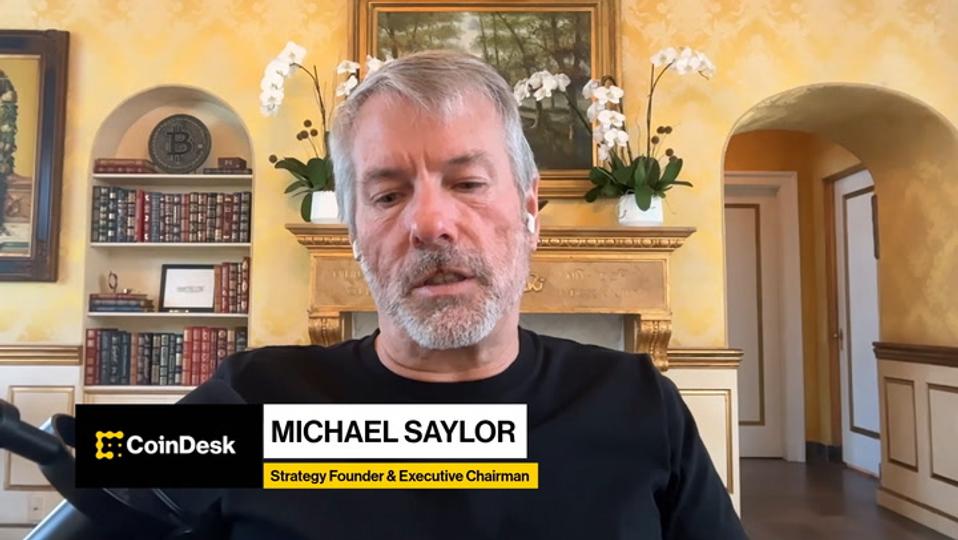
Markets turned panicky on Thursday as bitcoin (BTC) slid below $63,000, dragging down crypto-related equities and sending Michael Saylor's Strategy (MSTR) preferred stock, STRC, to a record low. The selloff came after the Federal Reserve's first policy meeting under new Chair Kevin Warsh delivered a hawkish surprise that rattled risk assets across the board.
Bitcoin fell about 4% in early afternoon trading to $62,500, its lowest level in weeks, before recovering slightly to hover near $63,000. The broader crypto market followed suit, with ether (ETH), XRP (XRP), and solana (SOL) posting even larger percentage declines. The selloff extended a pattern of weakness that began Wednesday after the Fed's updated dot plot showed nine of 18 policymakers now anticipate higher interest rates in 2026, signaling a more restrictive stance than markets had expected.
Strategy's Variable Rate Series A Perpetual Stretch Preferred Stock (STRC) bore the brunt of the panic. The security fell as low as $83.26 around noon ET—more than 16% below its $100 par value—before recovering to $88.59 at the close. The sharp intraday drop marked a new record low and prompted concerns about the viability of the company's bitcoin funding strategy. STRC was designed as a key tool for Strategy to raise capital for bitcoin purchases: when it trades above par, the company can issue new shares through an at-the-market program. With the stock now well below $100, issuance has been paused, potentially limiting new bitcoin accumulation.
The distress in STRC quickly spilled over into Strategy's common stock, MSTR, which fell 5.5% to near its 52-week low. This triggered a wave of bearish commentary from longtime crypto skeptics. Peter Schiff, a persistent critic, tweeted that "the financial house of cards Michael Saylor built is collapsing," adding that "soon, Saylor will trade in his orange tie for an orange jumpsuit." The Financial Times' Alphaville blog published an obituary-like piece arguing that STRC has become a "tapeworm inside the Strategy belly" that should be expelled. However, close observers noted that the FT has been consistently bearish on crypto and that similar obituaries had preceded past rallies—including one after bitcoin's crash to $60,000 in early February, which was followed by a 40% rally three months later.
Despite the panic in crypto, U.S. equities rebounded strongly from Wednesday's selloff. The S&P 500 rose 1.08%, the Nasdaq gained 1.91%, and the Dow Jones Industrial Average added 0.14%. AI-related stocks led the charge, with Nvidia, Broadcom, and AMD all up around 4%. Micron Technologies jumped 9%, and Intel soared 10.6% after President Donald Trump announced a chipmaking partnership with Apple on Truth Social. The divergence between AI and crypto highlighted a market that is increasingly discriminating between high-growth technology plays and speculative digital assets.
The macro backdrop was dominated by the Federal Reserve's hawkish tilt. Chair Warsh, in his debut FOMC meeting, held rates at 3.50% to 3.75% as expected, but the updated dot plot raised the median forecast for the end of 2026 from 3.4% to 3.8%. Markets now price a 34% chance of a rate hike at the July meeting—up from 8% before Wednesday—and a 67% chance of at least one hike by September. The U.S. Dollar Index (DXY) climbed to a one-year high above 100.7, tightening global financial conditions and pressuring risk assets.
Amid the selloff, on-chain data showed that bitcoin whales were buying the dip. Addresses holding 1,000 or more BTC now control about 7.17 million coins, their highest since March 14, according to Santiment. This accumulation came even as spot bitcoin and ether ETFs posted net outflows on Wednesday—bitcoin funds lost $82 million and ether funds $29 million, with even BlackRock's IBIT shedding $31 million. Exchanges have seen reserves fall by roughly 80,000 BTC since February, and long-term holder balances sit near all-time highs. However, whale holdings as a share of total supply remain below their December peak, suggesting that while accumulation is strong, it is not yet signaling a decisive trend reversal.
Mining stocks were a bright spot within the crypto sector, rising in sympathy with AI-related names as investors rotated into infrastructure plays. Cipher Mining (CIFR) jumped 10.7%, HIVE Digital (HIVE) rose 7.3%, and Hut 8 (HUT), TeraWulf (WULF), and IREN (IREN) all posted gains. The strength was also evident across semiconductors and memory stocks, with the VanEck Semiconductor ETF (SMH) up 5% and the DRAM ETF gaining 10%. This divergence between mining stocks and bitcoin price has been a recurring theme in 2026, as miners increasingly pivot to AI and high-performance computing to generate revenue.
On the options market, a bearish signal emerged in bitcoin derivatives. Data from Laevitas showed whale-sized buying of put options at the $62,000 strike expiring on June 21 (three days out). A total of 1,750 contracts were purchased, paying over $600,000 in premium. This positioned for a potential breakdown below $62,000 by weekend expiry, reflecting growing caution among sophisticated traders.
TD Cowen analyst Lance Vitanza provided a more nuanced view of Strategy's situation after meeting with CFO Andrew Kang. In a note Thursday, Vitanza said Kang described the company as increasingly positioning itself as a bitcoin-focused capital markets platform rather than a leveraged buyer. The primary goal remains growing bitcoin per share, but management is placing greater emphasis on liquidity, credit stability, and capital structure management. Kang characterized recent bitcoin sales and debt retirements as demonstrations of financial flexibility rather than signs of funding stress, and indicated that the company may slow accumulation during weaker market conditions but remains committed to long-term growth.
The broader crypto market continues to weigh the impact of the Fed's hawkish pivot. Matthew Pinnock, COO at Altura DeFi, noted that the near-term headwind is real, but the hawkish stance also signals the Fed's confidence in the economy. If AI-driven productivity supports growth and inflation stays contained, investors may come to view the posture as a sign of resilience rather than a persistent threat to risk assets.
As the U.S. trading day drew to a close, bitcoin was steady near $63,800, with total crypto market capitalization flat at $2.26 trillion. The selloff had eased somewhat, but the underlying tension between a hawkish Fed, collapsing preferred stock prices, and whale accumulation left the market in an uncertain state. The next test will come as traders assess the odds of a rate hike in October and whether the ETF bid can return.
Source: Coindesk News