

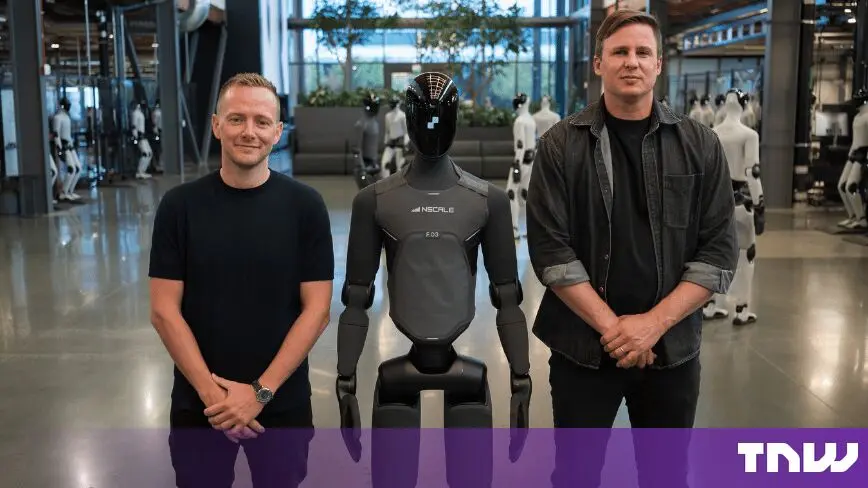
Nscale has agreed to sell Figure at least $3.5bn of computing power and has also bought a stake in the humanoid robot maker. That second part is what deserves attention. Nscale is ostensibly a cloud provider selling access to data centers. Figure is its customer. By taking equity in the customer, Nscale makes the commercial relationship more circular and acknowledges that demand for AI infrastructure cannot be measured purely by purchase orders.
Key facts at a glance
- Nscale will sell Figure at least $3.5bn in compute under an initial commitment.
- The agreement covers up to 100,000 Nvidia GPUs built on the Vera Rubin platform.
- First systems arrive in the second half of 2027 at Nscale's site in Barstow, Texas.
- Nscale has made an undisclosed strategic investment in Figure and will become its preferred compute provider.
- Figure will use the compute to train its Helix models.
- The companies intend to scale the arrangement beyond $6bn.
- Nvidia is an investor in Nscale and also an investor in Figure, placing the chipmaker on both sides of the contract.
A customer becomes a partner
Nscale announced the partnership on 3 September. Its founder and chief executive, Josh Payne, described the deal as a move toward physical intelligence, which he called AI's next frontier. In his view, Figure was pushing that frontier further than inference or agentic workloads do.
The commercial part of the deal is straightforward: Nscale gets a long-term tenant for GPUs at a new data center site, and Figure obtains a large volume of compute at a time when Nvidia's newest accelerators are tightly allocated. The ownership part is less straightforward. Nscale did not disclose how much equity it bought, but by becoming a shareholder it joins a widening group of infrastructure providers who are investing in their own customers.
An Nvidia playbook
Nvidia has often been called the most important investor in AI, not only because of its chips but because it has built an equity portfolio of about $99bn. Many of those stakes are in laboratories and cloud companies that buy Nvidia hardware. This creates a flywheel: Nvidia supplies the systems, the customer raises money partly because Nvidia has validated it, and Nvidia eventually benefits from the customer's growth.
Nscale and Figure happen to sit inside the same network. Nvidia is an investor in Nscale and an investor in Figure. Therefore the chipmaker is present on both sides of a contract that uses its own hardware. Nscale, sitting in the middle, now owns part of the downstream company. Jensen Huang, Nvidia's chief executive, has called this arrangement a robotics flywheel. Figure's models train on Vera Rubin through Nscale's cloud, Nvidia's Isaac Sim validates them, and then the models deploy on Nvidia GPUs inside Figure's robots. Nvidia silicon is used at every stage.
Wall Street worries
Some investors have warned that circular structures can make demand appear stronger than it is. If an infrastructure provider invests in a customer and simultaneously books revenue from that same customer, the revenue is real, but it becomes harder to know how much of the order is driven by market need and how much by the equity link. Nvidia's finance chief has used defensive language to describe those positions, saying the investments reflect long-term strategic partnerships rather than an attempt to inflate demand. Nscale's deal with Figure tests the same logic one level below the chipmaker.
Figure's own future
One line in the announcement suggests where this can lead. The companies said they will explore the use of humanoids inside Nscale's supply chain. In plain terms, Figure robots could eventually work in the data centers that are training Figure robots. No number or date has been attached, and that may remain an ambition. But it reveals the end state both companies are arguing for: a closed system where AI builds and maintains the infrastructure AI uses.
Data and compute
Figure's founder and chief executive, Brett Adcock, framed the principal constraint as data and compute. Helix, he said, improves in the same way that any learned system improves, with more of both. Figure has partly solved the data problem. Its Index program receives thirty minutes of human training video every second, contributed by paid creators through a phone app. The harder problem is turning that video into a robot capable of working a full shift. Sustained training runs require enormous compute clusters that Figure has not been able to line up until now.
Money has not constrained Figure either. In September 2025 the company closed a round of more than $1bn at a $39bn valuation. Parkway Venture Capital led the round; Nvidia, Intel Capital, Salesforce and Qualcomm Ventures participated. A year earlier, in 2024, Figure had raised a $675m Series B that included Microsoft, Amazon's Industrial Innovation Fund and Jeff Bezos. Adcock is also running a separate AI hardware startup called Hark, which raised $700m at a $6bn valuation in May.
Nscale's balance sheet before IPO
Nscale is making its commitment while preparing to go public. It closed a $2bn Series C at a $14.6bn valuation in March and then secured roughly $3bn of debt financing for campuses in Texas and North Carolina. Reports in August said it was seeking up to $3bn from a US IPO, possibly as soon as September. The company has told prospective investors that it holds about $51bn in contracted revenue, giving it a backlog large even by AI standards.
Nscale operates data centers in Narvik and Glomfjord in Norway, Loughton in Essex and Texas, with partner capacity in Portugal, Iceland and North Carolina. The Figure work is expected to land at its Barstow site. Nscale also said some of the backlog now points at a customer in which it holds equity.
The crowded humanoid market
The money flowing into humanoid robotics has accelerated. By one tally, humanoid startups have raised $8.6bn so far in 2026, roughly 1.8 times the amount raised in all of 2025. Skild AI took $1.4bn in January at a valuation above $14bn, with SoftBank leading and Nvidia and Jeff Bezos also investing. Apptronik pushed a Series A past $935m in February. Physical Intelligence was reported in March to be in talks for about $1bn at a valuation above $11bn; months later, no closing was confirmed.
The demand case is not imaginary. Barclays analysts have estimated that humanoid robots could offset about 60 percent of China's expected shortfall of 37 million workers by 2035. In manufacturing, logistics and elder care, companies are looking for machines that can move through human spaces and carry out repetitive work. Nvidia has pursued partnerships with several humanoid makers for the same reason.
What remains unproven is the economy of the loop. Building a humanoid robot is capital intensive, but the total addressable market is enormous. Analysts sometimes compare the current moment to the early days of autonomous vehicles, when investors funded fleets of test cars before the unit economics had been demonstrated. Humanoids need the same long runway. They also need data centers, factories and supply chains that can tolerate early failures.
The Nscale-Figure transaction is therefore more than a procurement contract. It combines capacity reservation, customer financing and vertical integration in one gesture. It lets Nscale book revenue from a company whose valuation depends on scaling, and it gives Figure a financial partner that could become one of its largest infrastructure suppliers. The outcome is not determined by the announcement or by the equity check. The test will be the first outside customer who chooses to buy Figure's robots for what the robots can do, not for the story attached to them.
Source: TNW | Investors-funding News