

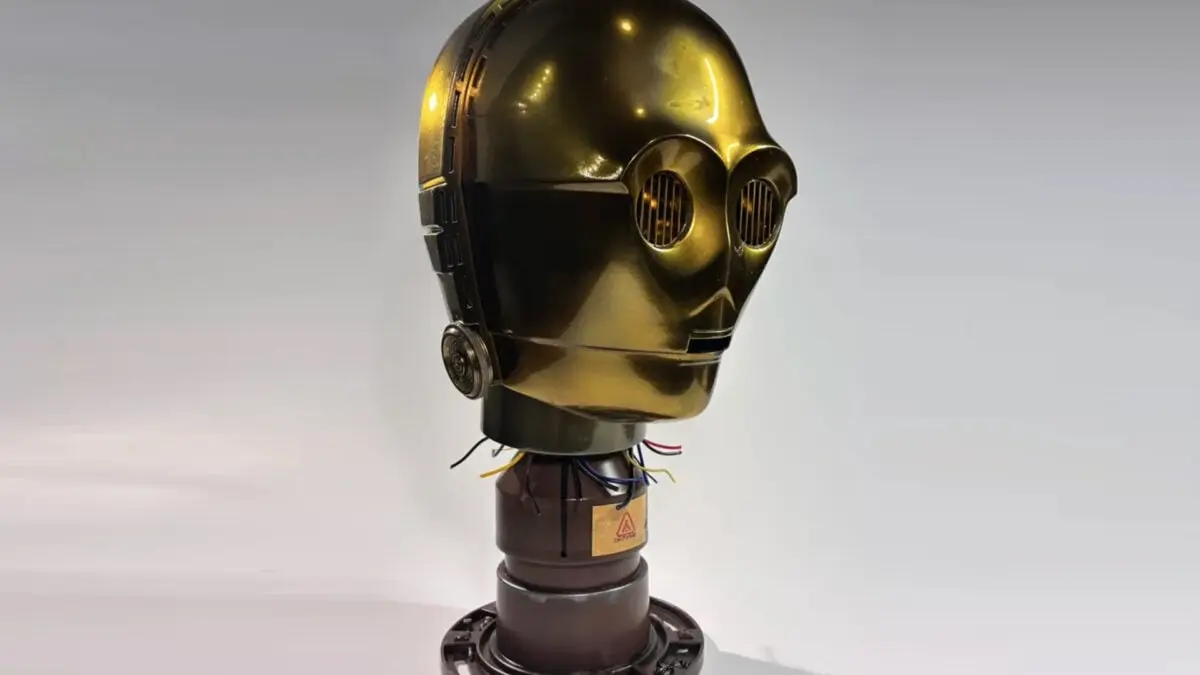
May the Fourth Be With You: A DIY C-3PO Head That Talks Back
Star Wars Day, celebrated annually on May 4th, brings fans together to honor the galaxy far, far away. While characters like Darth Vader and Luke Skywalker often steal the spotlight, one droid has quietly maintained a loyal following: C-3PO, the golden protocol droid known for his fussy demeanor and impeccable grammar. This year, a new project has given fans a unique opportunity to interact with the character in a way never before possible—by building their own talking C-3PO head powered by artificial intelligence.
The original head prop from The Empire Strikes Back recently sold at auction for over $1 million, making it one of the most expensive pieces of Star Wars memorabilia ever. But for those who cannot afford such a collector's item, Samuel Potozkin, a student at Chapman University in Orange County, California, has devised a far more accessible alternative. He built a DIY C-3PO head that not only looks the part but can also hold a conversation. The project is a testament to how modern technology can blend with pop culture to create something both nostalgic and innovative.
The Technology Behind the Golden Droid
Potozkin's creation relies on a Raspberry Pi 5, a small but powerful single-board computer that has become a favorite among hobbyists and makers. The device serves as the brain of the operation, processing input from a microphone and generating responses through a custom large language model (LLM) specifically trained to emulate C-3PO's prissy personality. The pipeline is deceptively straightforward: the user speaks into the microphone, the Raspberry Pi converts the speech to text, sends that text as a prompt to the LLM, and then transforms the LLM's response back into speech using a text-to-speech engine designed to replicate the droid's metallic vocal tone.
One of the most challenging aspects of the project was achieving the correct audio quality. Initial tests revealed that off-the-shelf text-to-speech systems failed to capture the metallic, tinny resonance characteristic of C-3PO. To solve this, Potozkin applied a series of post-processing effects that sound more like a guitarist's pedalboard than a typical audio filter. He introduced a short delay line to create tightly spaced temporal reflections, which mimics the hollow echo of a metal casing. Additionally, a chorus effect was applied by slightly modulating the time and pitch of duplicated signal paths, resulting in a layered vocal resonance that convincingly evokes the character's voice. The final output is so accurate that it would be recognizable even without the visual cue of the head itself.
Star Wars and the Legacy of C-3PO
C-3PO, originally built by Anakin Skywalker in The Phantom Menace, has been a constant presence throughout the Star Wars saga. Voiced by Anthony Daniels, the character is known for his anxiety, formality, and unending complaints. Despite being a supporting character, C-3PO has become a cultural icon, appearing in all nine mainline films, as well as spin-offs like Rogue One and television series such as Star Wars Rebels. His relationship with R2-D2—the beeping astromech droid—is one of the most beloved duos in cinema history, often providing comic relief amid the epic battles.
The appeal of a talking C-3PO head lies in its ability to let fans step into R2-D2's shoes, so to speak. R2-D2 communicates only through beeps and whistles, leaving the audience to infer his meaning. With Potozkin's creation, users can experience what it is like to be the plucky astromech, conversing with a verbose, somewhat condescending protocol droid. The project has garnered significant attention online, with many praising its clever use of AI and nostalgic design.
Expanding the DIY Robotics Community
Potozkin's work is part of a larger trend of hobbyists integrating AI into physical robots. From robotic companions like Sony's Aibo to custom-built R2-D2 replicas that navigate via autonomous algorithms, makers are pushing the boundaries of what is possible at home. The Raspberry Pi, in particular, has enabled countless projects because of its affordability and flexibility. By combining it with an LLM, Potozkin demonstrates how natural language processing can be deployed in non-traditional form factors.
The full details of the project are available on Potozkin's GitHub page, where he has published a paper covering the hardware, software, and audio processing steps. This open-source approach allows anyone with basic soldering and coding skills to recreate the build. In recent interviews, Potozkin has expressed hope that his work will inspire others to experiment with AI in creative ways, especially within the context of beloved franchises.
The timing of the release—shortly before Star Wars Day—was no accident. Fans looking for a conversation starter or unique centerpiece for their next viewing party now have a blueprint to follow. The head can be displayed on a coffee table, desk, or even mounted on a mannequin body. While the current version focuses on dialogue, there is potential for future upgrades, such as motorized eyes or lip synchronization.
Challenges and Future Directions
Building a talking C-3PO head is not without technical hurdles. The LLM must be fine-tuned to stay in character, avoiding modern slang or factual inaccuracies that would break the illusion. Potozkin's model was trained on a dataset of C-3PO's dialogue from the films, supplemented with instructions to maintain a proper tone. Additionally, the audio delay between speaking and receiving a response must be minimized for natural conversation flow. The Raspberry Pi 5's improved processing power helps in this regard, but further optimizations are possible with dedicated neural processing units.
Beyond the basic functionality, makers have already begun brainstorming modifications. Would it be possible to add Wi-Fi connectivity so the head could answer questions about the Star Wars universe? Could the voice be switched between C-3PO and other characters? Potozkin has left the software open-ended, encouraging contributions from the community. The project page includes a roadmap for future features, such as integration with voice assistants like Alexa or Google Assistant.
The success of this DIY project also raises interesting questions about fan engagement and intellectual property. While building a C-3PO head for personal use is perfectly legal, commercial versions would require licensing from Disney. However, the open-source nature of the build ensures that individual fans can continue to create their own without legal concerns.
Related Projects in the Maker Space
Potozkin's C-3PO head joins a long list of Star Wars-inspired DIY builds. Over the years, hobbyists have created life-size R2-D2 units that move, play sounds, and even project holograms. Some have attempted to build functional lightsabers using high-powered LEDs and realistic sound boards. However, few have integrated conversational AI to such a degree. The combination of a physical prop with natural language processing represents a new frontier in fan creations.
Other notable projects include the "BB-8 robot" from Sphero, which is a commercial product but can be customized with voice control via third-party apps. In the academic world, researchers at universities like MIT have developed social robots that can hold simple conversations, but Potozkin's work stands out for its focused application—recreating a specific character with a distinct personality.
The cost of such a project is surprisingly low. A Raspberry Pi 5 board can be purchased for around $80, and the remaining components—microphone, speaker, 3D-printed or foam head shell—add another $100–200. The LLM can be run locally or accessed via a cloud API (though local processing avoids latency and privacy issues). This affordability makes it accessible to students and enthusiasts alike.
As we look to the future, the intersection of AI and nostalgia will likely produce even more innovative fan creations. Whether it's a talking Buzz Lightyear or a sarcastic HAL 9000, the tools are now in place for anyone with a passion for tinkering to bring fictional characters to life. Potozkin's C-3PO head serves as an inspiring example of what is possible when technology meets storytelling.
Source: Gizmodo News