

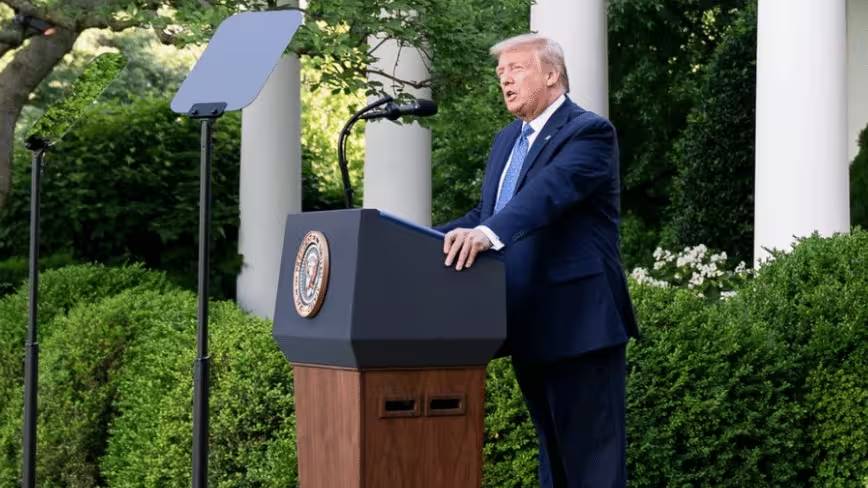
The two-day summit in Beijing between U.S. President Donald Trump and Chinese President Xi Jinping concluded without a signed AI governance framework, despite discussions on artificial intelligence guardrails and Nvidia's H200 chips. Trump, speaking to reporters aboard Air Force One on Friday, characterized the conversations as covering 'standard guardrails that we talk about all the time.' Yet the absence of any formal agreement, a recurring theme in U.S.-China tech diplomacy, leaves the most critical pieces of the bilateral technology relationship unresolved.
What Were the Key Topics?
While the public-facing portion of the summit focused on trade imbalances and the H200 chip question, behind closed doors, the leaders touched on a broader set of issues. According to sources briefed on the discussions, the two sides explored the possibility of working together on AI safety measures, but no concrete framework emerged. Trump added that they 'talked about possibly working together' on guardrails, but offered no specifics. The phrase 'standard guardrails' remains a diplomatic placeholder, as U.S. and Chinese governments have not yet formally agreed on what such guardrails would cover—whether they pertain to autonomous weapons, model misuse, or dual-use AI applications.
H200 Exports: Cleared but Not Shipped
One of the most closely watched outcomes of the summit was the status of Nvidia's H200 chips. Hours before the meeting on Thursday, Washington cleared roughly ten Chinese technology firms—including Alibaba, Tencent, ByteDance, JD.com, and Lenovo—to purchase up to 75,000 H200 chips each under a new export-licensing regime. However, as of the summit's conclusion, not a single H200 had shipped to any of the cleared buyers. The delay is attributed to an unusually elaborate export-licensing process. China-bound H200 volumes are capped at no more than 50% of Nvidia’s U.S. domestic sales. Each shipment must be verified by a U.S.-headquartered third-party laboratory, and Chinese buyers must certify that the chips will not be used for military purposes. Additionally, the deal includes a 25% revenue share routed through U.S. territory. So far, this has amounted to a paper clearance rather than a physical delivery.
The clearance marked a partial easing of restrictions originally imposed by the Biden administration, which had banned the export of advanced AI chips to China. Trump’s administration chose a different approach: allowing sales under strict controls, arguing that keeping Chinese demand within a regulated framework would preserve revenue for Nvidia and jobs in the United States. Nvidia CEO Jensen Huang publicly defended this position last week, noting that the H200 sits one generation behind the Blackwell line, which remains under full export controls. By selling controlled chips, the administration aims to slow China's indigenous AI chip development while maintaining a competitive edge.
Domestic political pushback was immediate. Senate Democratic leader Chuck Schumer posted that 'giving China access to this premier U.S. technology is dangerous and threatens our lead in the AI race.' His comment reflects a broader bipartisan concern that any technology transfer, even under strict supervision, could accelerate China’s military modernization or dual-use AI capabilities.
The Rare Earths Stalemate
The summit also failed to resolve the ongoing rare earths dispute. China imposed controls on rare-earth exports last year in retaliation for earlier U.S. tariffs. These controls have severely constrained Western magnet and motor supply chains, with exports remaining about 50% below pre-restriction levels. Despite the broader negotiations, rare earths and chips continue to be treated as part of the same negotiating folder on both governments' read-outs. They did not move together in Beijing, leaving a critical supply chain vulnerability for U.S. and allied manufacturers of electric vehicles, wind turbines, and defense systems.
The Corporate Stakes
Underlying the political drama is a massive corporate spending cycle. Hyperscalers have committed more than $650 billion to AI infrastructure across 2026, according to combined Q1 earnings reports from Microsoft, Alphabet, Amazon, Meta, and Apple. Nvidia sits at the center of that supply chain. A China revenue line—even at controlled volumes and with a 25% pass-through—would materially improve Nvidia’s medium-term forecast. Microsoft and OpenAI’s joint trajectory represents the visible U.S. half of that picture; on the other side, Huawei’s Ascend chips are the indigenous alternative that the export regime is implicitly trying to slow down. The longer H200 shipments remain suspended, the more breathing room Huawei has to improve its own offerings and capture Chinese market share.
What’s Next?
The two governments are said to be considering a recurring dialogue track on AI risk, but no schedule, working group, or signed text has emerged from this round. Senior officials briefing on background described the AI conversation as 'the elephant in the room' rather than the centerpiece, with deeper discussions on autonomous weapons, model misuse, and dual-use AI only covered in outline. Trump’s read-out from Air Force One was less a substantive AI-policy announcement than a procedural signal: the discussions happened, the H200 licensing regime remains in place, and the world’s two largest economies are still far from a grand technology bargain.
In the broader context of U.S.-China relations, the summit represents a continuation of the incremental, transactional style that has characterized both administrations. Past summits—from the 2017 Mar-a-Lago meeting to the 2023 San Francisco talks—have often produced glowing rhetoric but limited concrete outcomes on technology. The strategic rivalry over AI, chips, and rare earths is now a permanent feature of the bilateral relationship, one that will outlast any single summit or no, JFK.
For now, the corporate world watches closely. Nvidia’s stock price fluctuates with every rumor of export easing or tightening. Chinese hyperscalers like Alibaba and ByteDance are building massive AI data centers but remain dependent on imported silicon for the most advanced workloads. Rare earth producers in China are weighing the cost of continued export controls against the risk of losing market share to emerging sources in Australia, Brazil, and the United States. And governments on both sides are learning that AI governance—whether through guardrails, export controls, or technical standards—is a long-term game that cannot be settled in a single summit.