

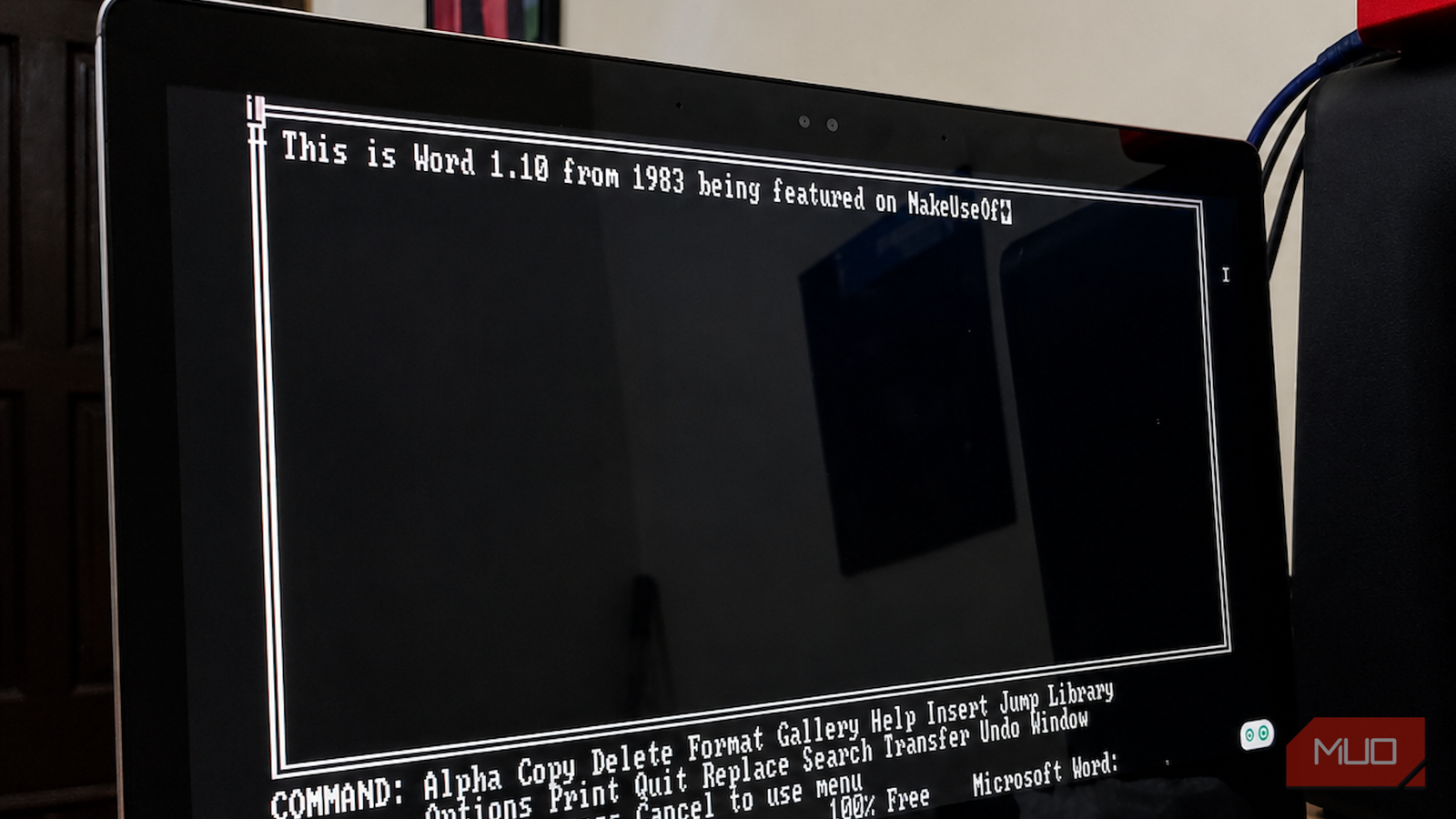
Microsoft Word and Windows are so tightly linked in personal-computing history that many users assume the two products were born together. The assumption is understandable: Word has lived on Windows for decades, and the word processor became an industry giant only after Microsoft's operating system dominated the desktop. Yet Word's actual beginning undermines that neat story. The application was developed years before Windows reached the market, and its earliest version was created not for DOS or Windows but for Xenix, Microsoft's own Unix-like operating system.
Microsoft in the early 1980s was a very different company from the one that later became synonymous with Windows. It supplied programming languages to several computer makers, licensed DOS to IBM, and also invested heavily in Unix. That Unix project, named Xenix, helped shape Word even though it has largely faded from popular memory. Here are the key facts from that strange beginning:
- Microsoft announced Xenix in August 1980 as a portable Unix system for 16-bit processors, years before Windows was even a public project.
- Word began as Multi-Tool Word. Charles Simonyi and Richard Brodie built it first for Xenix in early 1983.
- Word for MS-DOS shipped in 1983, before Microsoft announced Windows 1.0 in November of that year.
- Windows 1.0 itself did not ship until November 1985, two years after Word was already on sale.
- The Mac version of Word arrived in 1985, ahead of Word for Windows, which did not appear until 1989.
- Word for Windows became a market leader only after Windows 3.0, and by 1993 it reportedly held about half of word-processing market revenue.
Microsoft had a Unix life before Windows
The idea of Microsoft selling Unix sounds like a weird alternative-history detour, but Xenix was very real. Microsoft announced it in August 1980, positioning it as a portable operating system for the growing field of 16-bit microprocessors. By 1982, the company was already using several Xenix machines internally, a sign that Microsoft had confidence in its own operating system. Microsoft also worked with the Santa Cruz Operation to develop and support Xenix across multiple hardware platforms.
Xenix quickly became an important part of Microsoft's business. Microsoft would later describe it as the most popular Unix variant by 1984, a claim that may sound unlikely in hindsight but made sense at the time. IBM even selected both Xenix and MS-DOS for the IBM PC AT in 1984, demonstrating that the future of desktop operating systems was still open. The path that led to Windows everywhere was not the only path Microsoft considered.
This is the context in which Word was born. Word did not emerge from a company devoted to Windows; it emerged from a company experimenting with many platforms, including Unix. The decision to write Word on Xenix was practical and strategic. It allowed Microsoft to use a more powerful, flexible environment than DOS offered at the time, and it reflected the engineering culture that had arrived from Xerox's famous Palo Alto Research Center.
From Xerox PARC to Multi-Tool Word
Word's connection to graphical computing began before Microsoft ever named the product. Charles Simonyi joined Microsoft in 1981 after spending years at Xerox PARC, where he worked on Bravo, one of the first WYSIWYG text editors. Bravo ran on the Xerox Alto, a machine with a graphical display and a mouse years before such tools were common on commercial PCs. Simonyi's experience with Bravo shaped his ideas about how writing software should look and behave.
Simonyi later brought Richard Brodie, another former Xerox employee, into Microsoft. Brodie began work on the company's new word processor in 1982. The program initially went by the extremely 1980s corporate name Multi-Tool Word. According to the UK National Archives' PRONOM database, Simonyi and Brodie developed the program first for Xenix in February 1983, with a version for MS-DOS following later that year. Brodie himself has said that the first version was developed on Xenix, although that does not necessarily prove the Xenix build was the first version to be sold commercially. Either way, Word's earliest development happened on Unix.
The influence of Xerox PARC was visible in the way Word approached editing. Bravo could show formatted text on screen in a form that closely matched the final printed document, helping establish the WYSIWYG style of word processing that later became standard. That idea carried directly into Word, even though the DOS platform of 1983 was not well suited to fully graphical editing.
Word reached the market before Windows was real
Microsoft gave the DOS release of Word a remarkably aggressive launch. Its corporate timeline says that Word for MS-DOS 1.00 shipped on September 29, 1983, with a demonstration copy sent to PC World subscribers. The Computer History Museum puts the number of demo disks distributed at roughly 450,000, an enormous number for a software product at that time. Microsoft's own later history gives October 25 as the release date for Word 1.0, so the available records are not perfectly consistent. What remains clear is that Word was already being sold in 1983, before Microsoft announced Windows 1.0 that November.
The fact that Word came first matters because the familiar story of Microsoft often treats the operating system as the starting point. In reality, the people building Word had a different target in mind. They wanted to move word processing toward the graphical future they had seen at Xerox PARC. DOS, with its text-mode screen, could not deliver all of that experience. Yet Microsoft released Word on DOS anyway, and the product became one of the first commercial attempts to bring mouse-driven editing and formatting features to a broad PC market.
The DOS version of Word was also shaped by the same flexible approach that produced Xenix. Microsoft did not yet have a single platform that it expected to define all of its software. Word was going to appear wherever it could find an audience, which is why Microsoft later announced Word for Apple's Macintosh in January 1984, alongside the Mac itself, and released it commercially in 1985.
The DOS version was ahead of its time and held back
Early Word felt unusual for its time because of the ideas it borrowed from graphical research projects. The DOS version supported a mouse, style sheets, multiple windows, undo, footnotes, mail merge, and formatting that could change as a person typed. Those features were not common in the early word-processing market. Microsoft clearly believed that computing was moving in a more visual direction, and Word was designed to be ready for that shift.
The hardware available in 1983 could only take the idea so far. Simonyi later explained that the IBM PC's character-based display could approximate the visual editing experience, but proportional character widths and other details still required a genuine graphical display. Put simply, the DOS screen could show where formatting existed, but adding formatting to a paragraph was not the same as seeing it appear exactly as it would look when printed. That gap between Word's ambitions and DOS's abilities would define its early years.
There was also serious competition. PC users at the time were familiar with WordStar and WordPerfect, and Microsoft's newcomer behaved differently. The Computer History Museum describes Word for DOS as an also-ran compared with WordPerfect, which is a long way from the market dominance Word would one day have. Many users saw Word as strange or difficult because it introduced mouse-driven commands, style sheets, and screen formatting at a time when the leading programs relied on simpler, more predictable text interfaces.
Apple's Mac gave Word a better stage
Microsoft did not wait for Windows before pursuing a graphical version of Word. When Apple introduced the Macintosh in January 1984, Microsoft announced that Word would be available for the new machine. The Mac version of Word appeared commercially the following year. For Simonyi and his team, the Mac was a much more natural fit because it had a bitmap display, a mouse, and a user interface built around graphical concepts.
In his oral history for the Computer History Museum, Simonyi said Microsoft was especially well positioned for the Mac because its applications development group already understood graphical interfaces. The team's time at Xerox PARC and its experience with the Alto gave it an unusual advantage. While other software companies were still adjusting to DOS, Microsoft had been thinking about graphical word processing for years. The Mac release proved that Word could thrive on the right hardware, even if the DOS product had struggled.
Microsoft's decision to create Word for Apple's Mac also reinforced the broader point that the company in the 1980s was not yet defined by Windows. Microsoft built software for multiple platforms and was happy to work with Apple when it made business sense. The Mac version of Word became an important product and showed how the word processor might evolve once it was free from the limits of text-only DOS screens.
Word for Windows was the final piece
Word for Windows did not arrive until 1989, six years after the original DOS release. By that time, Windows had been available in various forms since 1985, but it had not yet become a mainstream platform. The timing of Word for Windows mattered because Windows 3.0 followed in 1990. Windows 3.0 was the version that made Microsoft's graphical operating system a practical and attractive platform for millions of PC users, offering the kind of graphical environment that Word had been designed for from the beginning.
Once Word for Windows had that stronger foundation, its fortunes changed quickly. According to the Computer History Museum, Word for Windows was generating roughly half of word-processing market revenue by 1993. That was an extraordinary turnaround for a product whose DOS ancestor had spent years as an also-ran behind WordPerfect. The combination of Word and Windows finally became the standard that later generations would assume had always existed.
Word's strange origin explains a lot
What makes Word's early history so revealing is how clearly it captures a different Microsoft. This was a company that sold Unix, hired researchers from Xerox PARC, and built major software for whichever platforms seemed worth betting on. Word passed through Xenix, DOS, and the Mac before Windows became the platform that turned it into a giant. The Word-and-Windows pairing feels almost preordained now, but Word spent its first several years navigating a much wider software landscape while Microsoft was still figuring out which direction would define its future.
Source: MakeUseOf News