

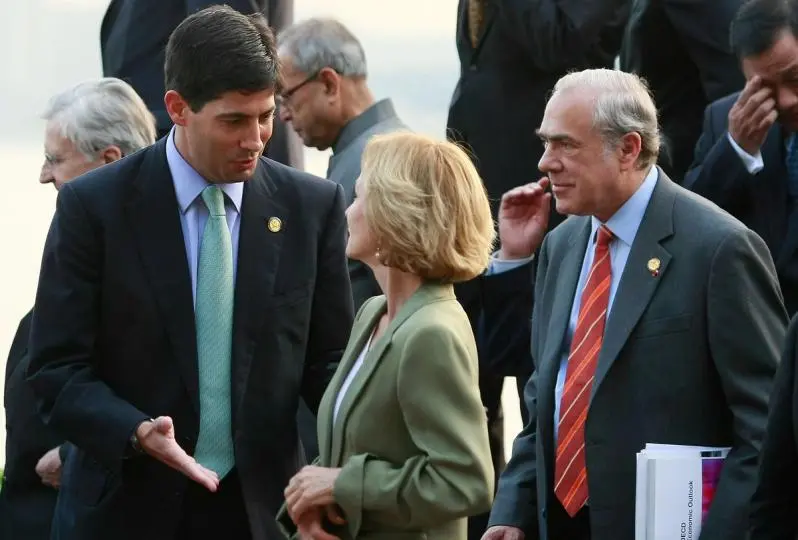
The Federal Reserve held its benchmark interest rate steady at 3.50%-3.75% during its first policy meeting under new Chair Kevin Warsh, but the accompanying statement and updated projections signaled a decisive hawkish shift. The central bank removed any language suggesting a bias toward easing, replacing it with a stark commitment: “The Committee will deliver price stability.” Markets reacted swiftly, with bitcoin dipping about 1% to $65,300, the Nasdaq falling 0.5%, and the two-year Treasury yield jumping nine basis points to 4.14%.
The Fed’s updated dot plot now projects the year-end fed funds rate at 3.8%, up from 3.4% three months ago. Notably, Chair Warsh did not submit his own estimate to the “dots,” consistent with his long-held skepticism about forward guidance. Nine of the 18 FOMC members who submitted projections now expect a rate hike in 2026, a sharp reversal from the rate-cut expectations that dominated markets earlier in the year.
Bitcoin (BTC) fell roughly 1% immediately after the decision, then recovered slightly to trade near $65,600 during Warsh’s press conference. Coinbase (COIN) ended the day about 2% lower, while Robinhood (HOOD) bucked the trend with a 9% gain. Bitcoin miner Marathon Digital (MARA) closed more than 3% lower. The broader crypto market remained under pressure, with ether (ETH) down 1.2% and Solana (SOL) losing 1.8%.
The hawkish turn was not limited to crypto. U.S. stock indexes deepened their losses as the session wore on. The Nasdaq and S&P 500 each fell more than 1% as the two-year yield soared a total of 14 basis points to 4.19%. Interest rate traders priced in a 28% probability of a rate hike at the Fed’s July meeting, up from just 8% before the announcement.
Fitch Weighs In: ‘New Leadership, Not a New Inflation Regime’
Fitch Ratings commented on the decision, noting that the Fed remains focused on preventing a renewed inflation surge under Warsh. “The Kevin Warsh era may signal a new leadership chapter, but not a new inflation regime,” said Olu Sonola, Fitch’s head of U.S. economics. He warned that policymakers are still haunted by their underestimation of inflation earlier in the decade and are unlikely to tolerate a similar mistake. “There is early evidence that price pressures may be extending beyond energy,” Sonola added, suggesting that if broader inflation continues to build, the Fed may be forced to tighten policy further. Rather than waiting for inflation to become entrenched, the central bank’s current stance indicates a shift from patience to preemption.
While easing tensions in the Middle East have pushed oil prices down roughly 30% since the March FOMC meeting, the Fed chose to emphasize the persistence of core inflation. Brent crude fell to around $75 per barrel, a disinflationary tailwind, but the committee nonetheless opted for a hawkish pivot. Lekker Capital CIO Quinn Thompson noted the irony: “Oil is down 30% since the FOMC’s last dot plot… Yet the committee somehow chooses now is the right time for their hawkish pivot.” Thompson, who has argued that markets may be overestimating the likelihood of rate hikes, pointed out that CME FedWatch now implies an 80% chance of one or more rate increases by the end of 2026.
Strategy’s STRC Plunges to New Lows
Strategy’s high-yielding preferred stock, STRC, extended its losses following the Fed’s announcement, sinking to $89 during the session before recovering slightly to $90.65. The security has been pitched by Michael Saylor as akin to a high-yield savings account, but critics note that savings accounts do not typically lose 11% of their value in a short period. STRC was designed to trade near par at $100, but has fallen far below that level.
Peter Schiff commented on X: “Risk-averse retirees whom Saylor convinced to buy last month are already down over 10.5%, almost an entire year’s 11.5% yield. Worse, to bail them out, Strategy will have to raise the yield to 13%, destroying more common shareholder value.” Strategy itself responded on X, noting that the company has 32 years of STRC dividend coverage via its bitcoin holdings. MSTR common stock closed down 3.5% as bitcoin slipped about 1% to $64,300. The preferred stock’s meltdown has been described as the largest “de-peg” ever, with the security falling well outside its intended trading range.
The Fed’s hawkish tilt adds another layer of pressure. If the central bank does hike rates this year, STRC would face increased competition from higher-yielding savings accounts and bonds, further undermining its appeal. Analysts have questioned how Strategy will continue funding the dividends on STRC, especially as the underlying bitcoin holdings have not appreciated enough to cover the yield.
SpaceX Turns Negative for the First Time
SpaceX (SPCX), the recently IPO’d high-flyer, also succumbed to the broader market selloff, falling 5.5% shortly before the close. Despite that decline, the stock remains up 40% from its IPO price of $135, indicating the extent of its prior gains. The two-year Treasury yield surged 17 basis points to 4.22% as markets quickly priced in rate hikes. The Nasdaq fell 1.35%.
The move lower in SpaceX highlights the breadth of the selloff, which affected even the most popular names. Analysts noted that the rate-sensitive nature of growth stocks made them particularly vulnerable to the hawkish pivot. The broader market rotation out of Big Tech also contributed, with the Magnificent Seven all trading in the red. The MAGS ETF fell roughly 9% from its May all-time high as investors shifted into sectors like semiconductors and memory.
President Trump Comments on Fed Decision
Speaking to reporters in France at the G7 meeting, President Trump said the Fed’s decision to hold policy steady “seemed alright” with him. Of the possibility of rate hikes, Trump allowed that it could happen. This marks a notable shift from his earlier stance, when he spent much of 2025 and early 2026 arguing for the Fed to cut rates sooner, even nicknaming then-Chairman Jay Powell “too late.” Trump appears to have accepted that the Fed’s next move will likely be tighter policy, as both the economy and inflation continue to grow.
Trump’s comments came as the dollar index (DXY) held just under 100, and gold traded little changed at $4,327 per ounce. Oil remained near $76 per barrel as geopolitical tensions eased following the U.S.-Iran deal. The combination of lower energy prices and a stronger dollar could provide some disinflationary pressure, but the Fed clearly remains focused on core inflation.
Warsh Announces Task Force on Monetary Policy Reforms
In his post-meeting press conference, Chair Kevin Warsh said the bank recognizes inflation is well above its 2% goal. “Persistently high prices are a burden to the American people,” he stated. Warsh announced he would appoint a task force to look at reforms in five areas of monetary policy: Fed communications, the balance sheet, use and reliance on existing data sources, productivity and jobs, and the bank’s inflation frameworks.
The announcement was seen as an attempt to address long-standing criticisms of the Fed’s transparency and forecasting accuracy. Warsh, a former Fed governor, has been a vocal critic of the central bank’s reliance on complex models and forward guidance. The task force will report its findings by the end of the year, potentially leading to significant changes in how the Fed communicates its policy intentions.
Markets initially recovered some of their losses during the press conference. Bitcoin climbed back above $65,600, and the Nasdaq turned positive for a brief period before resuming its decline. The volatility underscored the market’s sensitivity to any hints about the future path of monetary policy.
Polymarket Denied Restraining Order in Michigan
In other news, a federal judge in Michigan denied Polymarket U.S.’s motion for a temporary restraining order that would have blocked the state from suing the prediction market platform. Judge Paul Maloney ruled that Polymarket did not demonstrate it would succeed on the merits in the broader action. “There is no clear statement that Congress intended to supersede the states’ traditional role in regulating gambling,” the judge wrote. Polymarket had sued in March to prevent Michigan from taking enforcement action, arguing that federal law preempts state gambling regulations. The decision is a setback for the platform, which has faced increasing scrutiny from state regulators.
The ruling came as prediction markets gained attention following Schwab’s announcement of S&P 500 event-based options. The broader regulatory environment remains uncertain, with states taking divergent approaches to crypto and prediction markets.
Bitcoin On-Chain Signals Point to Bear Market Bottom
Despite the short-term selling pressure, several on-chain indicators are flashing bullish signals. Bitcoin’s RHODL Ratio, which compares wealth held by long-term holders against fresh short-term capital, is beginning to roll over from its peak. This pattern previously emerged at the 2015 and 2022 cycle bottoms, both of which marked the end of brutal bear markets before major recoveries. Long-term holders are reasserting dominance, suggesting capital rotation is shifting.
The Sharpe ratio, which measures risk-adjusted returns, fell to -20 on June 11, a level that has marked every bear-market bottom since 2015. While the metric stayed below the line for several months in each previous cycle, it signals that the floor is forming rather than that a rebound has arrived. Exchange reserves have fallen roughly 80,000 BTC since February to about 2.71 million, and whales have pulled more than 11,000 off exchanges in the past day. Accumulator wallets took in about 125,000 BTC in the first half of June.
Bitcoin’s order book on Binance is showing a notable bullish shift. The order book imbalance, which measures buy-side liquidity relative to sell-side liquidity, has surged to its highest level since at least February 2024, according to Glassnode. This indicates that passive buy orders are stacking up more aggressively relative to sell orders, a pattern typically associated with renewed investor demand.
However, analysts caution that these on-chain signals measure accumulation and exhaustion, not flows. The driver of bitcoin’s recovery from its $59,130 low to about $65,800 was the U.S.-Iran deal, not the metrics. Today’s FOMC decision, Kevin Warsh’s first as chair, is the next test. A hold was nearly fully priced, so the dot plot and Warsh’s tone on inflation will decide whether the recovery extends.
Mid-June Seasonal Weakness for Bitcoin
Historical data shows that mid-June has often been a period of weakness for Bitcoin. Over the past several years, the cryptocurrency has frequently found a local bottom during this period. In June 2021, bitcoin plunged roughly 50% from its April highs due to the China mining ban. In June 2022, it fell to approximately $17,000 amid the collapse of Three Arrows Capital and the insolvency of Celsius. In June 2023, bitcoin traded below $25,000 after retreating from its April rally peak. In June 2024, bitcoin consolidated around $65,000. And in June 2025, it hovered near $100,000 before rallying to new all-time highs in July.
The current year’s pattern appears to be repeating, with bitcoin briefly dipping below $60,000 earlier in the month before recovering to the $65,000 range. The seasonal pattern suggests that patience may be rewarded, especially if the Fed’s hawkish stance proves temporary.
Scaramucci Predicts Late 2026 Rally
Anthony Scaramucci, CEO of Skybridge, remains bullish on bitcoin and crypto. He emphasized that he continues to hold a significant position and views the current market apathy as an opportunity rather than a warning sign. Scaramucci expects bitcoin to begin rallying in late 2026 and continue into early 2027. He also dismissed concerns about Strategy, saying he believes Michael Saylor’s long-term conviction will ultimately be rewarded. Drawing on nearly four decades of investing experience, Scaramucci noted that depressed RSI levels, weak sentiment, and thin market liquidity mean even modest demand could drive bitcoin sharply higher.
The broader market remains cautious, with bitcoin ETFs showing early signs of recovery after shedding more than $5 billion since May 15. BlackRock’s IBIT has continued to attract demand, adding over $150 million over four consecutive days. Even so, the sector has still recorded $54 million in net outflows so far this week, putting it on track for a sixth straight week of withdrawals.
The key question now is whether the spot bitcoin ETFs can halt the outflow trend and return to sustained inflows. The Fed’s hawkish pivot may complicate that recovery, as higher interest rates tend to reduce the appeal of risk assets. However, if inflation begins to moderate and the Fed’s tone softens, the on-chain signals suggest that a durable recovery could be on the horizon.
Source: Coindesk News