

The United Nations has consolidated its concerns about artificial intelligence into a single document, and the headline finding is unmistakable: AI capabilities are accelerating faster than any government's ability to understand, test, or regulate them. The warning arrived as delegates gathered in Geneva for the opening of the UN Global Dialogue on AI Governance, landing into a policy landscape where the European Union's AI Act remains one of the few binding frameworks anywhere in force.
The document behind the warning is a preliminary report from the UN's Independent International Scientific Panel on AI, released on 1 July and billed as the first comprehensive global assessment of the technology. Its central claim is a gap: between what AI systems can now do and the scientific understanding needed to govern them. Regulation is lagging, the panel argues, but so is the foundational research that policymakers would need to write good rules in the first place.
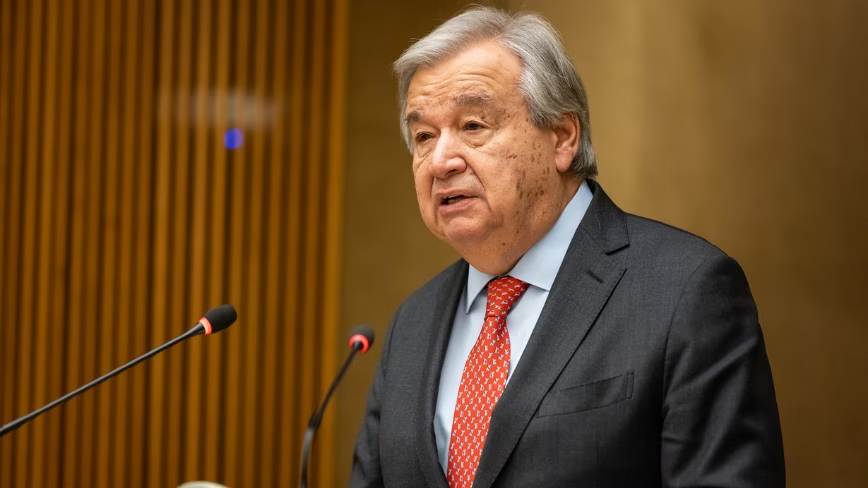
Secretary-General António Guterres delivered the message in plain terms. “The more AI advances without shared rules, the less say governments and people will have in the outcome,” he told reporters, before reducing his advice to governments to two words: “Do not wait.” He returned to the theme of comprehension more than once. “The world cannot govern what it cannot understand,” he said, adding that “the potential is great, but the risks are real, and the cost of waiting is rising.”
That framing—governance chasing an object it cannot yet measure—gives the report its force. The panel is not primarily warning about any single catastrophic scenario. It is warning about a structural mismatch, in which the pace of capability gains outruns the slower work of evaluation, standard-setting, and law. This is a familiar complaint among researchers who study AI governance, but it carries new weight given the authority of the UN behind it.
The Report's Core Findings
The 100-page preliminary assessment synthesizes inputs from over 1,200 experts worldwide, drawing on data from academic institutions, industry labs, and civil society. It identifies three key areas where the gap between AI advancement and governance is most pronounced: technical understanding, economic impacts, and global equity. On technical understanding, the panel notes that even leading AI developers often cannot fully explain how their most advanced models reach decisions, making it difficult to audit for bias, safety, or reliability. On economic impacts, the report warns that automation and AI-driven productivity could displace millions of jobs in sectors from manufacturing to professional services, but that the distribution of these effects is poorly understood. On global equity, the experts highlight that access to compute power, data, and AI talent is concentrated in a handful of countries and corporations, risking a new digital divide that could entrench existing inequalities.
The panel also addresses the challenge of measuring AI progress itself. Current benchmarks, it argues, are often narrow, easily gamed, and fail to capture real-world capabilities or risks. The report calls for the development of standardized, independent evaluation frameworks that can keep pace with rapid technological change. Without such frameworks, policymakers are left to regulate in the dark.
Fragmented Global Responses
The obvious objection to the UN's warning is that governments are not doing nothing. The European Union has a risk-based rulebook in force, however unevenly it is being implemented across member states. China has moved to restrict humanlike AI agents, forcing changes to consumer products already on the market. The United States, by contrast, has struggled to produce durable federal rules at all, a vacuum that critics say leaves the country poorly placed to regulate the industry it largely hosts. The panel's point is that these efforts are fragmented, and that fragmentation itself is a risk. AI systems operate across borders, and regulatory divergence can create loopholes, complicate compliance, and allow risks to migrate to jurisdictions with weaker governance.
The UN has been careful to frame the panel as advisory, a scientific body modelled loosely on the climate assessments that inform intergovernmental negotiations without dictating them. Whether that model can move at the speed the report itself describes is the open question. Intergovernmental processes are deliberate by design, and the panel's core finding is that AI is not. The climate parallel is instructive in both directions: the assessments have produced a shared body of evidence, but decades of them have not guaranteed decisive action. The panel is betting that a common scientific baseline is still worth having, even when the politics lag behind it.
Global Dialogue on AI Governance
The Geneva dialogue, which began on 2 July, is the first of a series of meetings intended to build a roadmap for international AI governance. Participants include government representatives, tech executives, academics, and civil society leaders. The agenda covers issues such as transparency standards, accountability mechanisms, and the role of international institutions. The dialogue is expected to produce non-binding recommendations by the end of the year, which could then be taken up by the UN General Assembly. However, the panel's own report warns that voluntary guidelines alone may not be sufficient to address the scale of the challenge, and that binding treaties or regulatory bodies may eventually be necessary.
There is also an equity argument threaded through the assessment. The experts caution that the window to shape AI is closing, and that if it closes with the technology concentrated in a handful of firms and countries, the result could widen global inequality rather than narrow it. Access to compute, data, and talent is not evenly distributed, and neither is the capacity to govern. The report recommends targeted investments in AI research and infrastructure in developing countries, as well as technology transfer and capacity-building programs. It also calls for a moratorium on the deployment of certain high-risk AI systems until independent safeguards are in place—a proposal that is likely to be contested by industry.
The UN's initiative comes amid a flurry of other international efforts. The OECD has updated its AI principles, UNESCO has adopted an ethics framework, and the G7 and G20 have launched working groups. The World Economic Forum has convened its own AI Governance Alliance. But these initiatives often overlap, compete for attention, and lack enforcement mechanisms. The UN panel hopes to provide a coherent scientific foundation that can harmonize disparate efforts and guide priority-setting.
Critics of the panel's approach argue that focusing on scientific consensus may slow down policy action, especially in areas where evidence is incomplete. They point to the precautionary principle as a more appropriate framework for risks that are potentially catastrophic, such as the development of autonomous weapons or AI systems that could cause widespread economic disruption. Supporters counter that without rigorous science, regulations risk being either too weak or too restrictive, and that policymakers need a common knowledge base to make informed decisions.
What the Report Does Not Do
What the report does not do is prescribe a specific institution or treaty. It feeds instead into the Geneva dialogue, which is meant to be the beginning of a process rather than a decision point. The UN has been careful to frame the panel as advisory, a scientific body modelled loosely on the climate assessments that inform intergovernmental negotiations without dictating them. Whether that model can move at the speed the report itself describes is the open question. Intergovernmental processes are deliberate by design, and the panel's core finding is that AI is not.
The climate parallel is instructive in both directions: the assessments have produced a shared body of evidence, but decades of them have not guaranteed decisive action. The panel is betting that a common scientific baseline is still worth having, even when the politics lag behind it. The coming months will test whether the UN can translate scientific warnings into concrete governance measures before the gap between AI's capabilities and the rules that constrain it becomes too wide to bridge.
In the meantime, Guterres's advice to governments remains stark: “Do not wait.” The report makes clear that the cost of waiting is not just measured in missed opportunities, but in elevated risks that could affect every dimension of human life—from work and privacy to security and democracy. The question now is whether the world's institutions can overcome their own inertia and match the pace of the technology they seek to govern.