

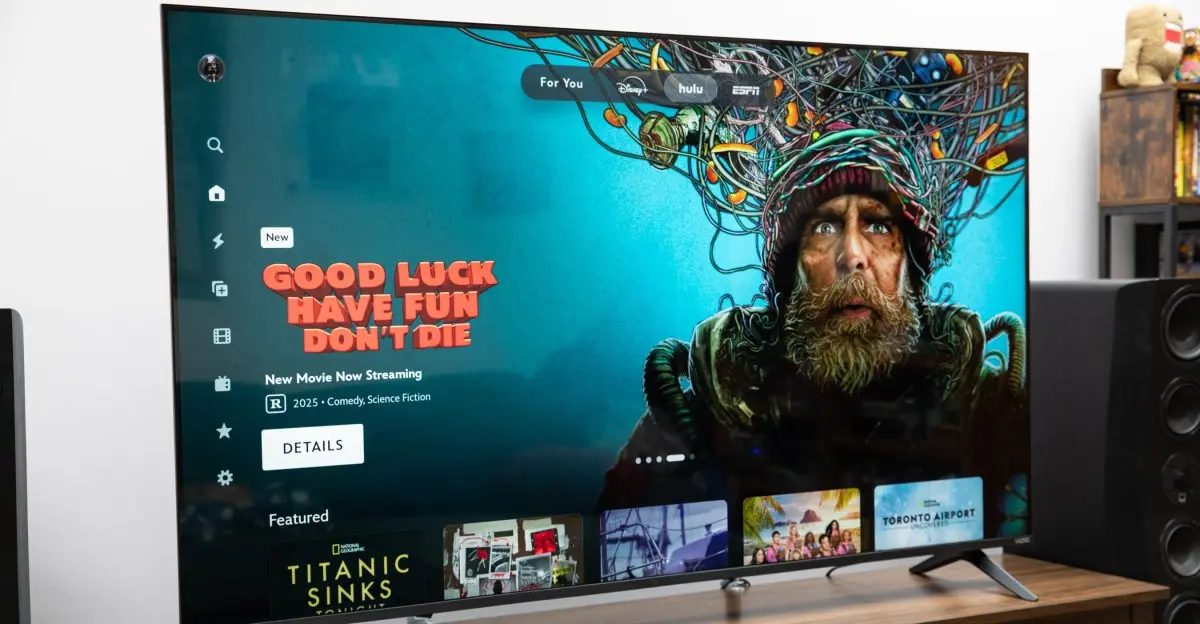
When Vizio released its 65-inch Mini LED Quantum TV earlier this year, the headline was clear: the company was back. After being acquired by Walmart in 2024, Vizio had been largely quiet. Now it was releasing a quantum-dot TV for under $398—the cheapest on the market. Quantum dots allow for higher brightness and more accurate color, so this seemed like a strong comeback move. But as I tested the TV, I realized the real story wasn't the price or the picture quality. It was that Vizio had accidentally created the best dumb TV money can buy.
The unexpected benefit of a Walmart-owned Vizio
Walmart bought Vizio primarily for its advertising business. At the time of the sale, Vizio's ad division generated all of the company's profits. Keeping that ad revenue flowing was the priority, and Vizio's TV operating system is the vehicle for it. During setup, you're asked to sign in to or create a Walmart account. If you decline, you're warned that you won't be able to manage payments and subscriptions or link your Vizio devices. But you can keep declining. After the Walmart account prompt, you're asked to accept an activity data policy. If you refuse that as well, you're told that you'll miss out on all smart TV features, including apps like Netflix, YouTube, and others. One more decline, and the TV becomes a dumb display: no OS, no tracking, just three HDMI ports waiting for a signal.
This is a crucial distinction from other smart TVs. On most platforms—whether it's Roku, Google TV, or Amazon's Fire TV—you cannot fully disable the smart features without voiding warranties or performing complex hacks. Vizio, likely because of its focus on advertising, built a setup flow that allows a complete opt-out. It's almost certainly an oversight, as the company would prefer you use the smart features and share your data. But for now, the loophole remains, and it makes the Mini LED Quantum the ideal dumb TV for privacy-conscious buyers.
Picture quality that punches above its weight
As a dumb TV, the Vizio Mini LED Quantum is excellent. I watched several World Cup matches using an over-the-air antenna and weekly shows like Last Week Tonight through an Apple TV. The picture modes include Calibrated and Calibrated Dark, which are the most accurate out of the box. Calibrated Dark is best for dark rooms, delivering high color accuracy and decent black levels. Calibrated reaches 936 nits of peak brightness in HDR, which is remarkable for a sub-$400 TV. That brightness helps the TV hold up well in bright rooms, although the glossy screen can be reflective. There's some motion blur during fast sports, but most viewers won't notice it. The black level isn't as deep as more expensive VA-panel TVs, and you can see some blooming around bright highlights. Still, for everyday viewing, the Vizio delivers a satisfying picture.
Under the hood, the TV uses an IPS panel with mini LEDs and quantum dots. The mini LEDs provide better local dimming than standard LEDs, though the number of zones is limited. HDR support includes Dolby Vision, HDR10+, HDR10, and HLG, covering all major formats. Audio support includes Dolby Atmos and DTS:X, but the built-in speakers are only adequate. For a better experience, you'll want a soundbar, which is typical for budget TVs.
Connectivity and build quality trade-offs
To hit the low price point, Vizio made compromises. The TV has only three HDMI 2.0 ports, whereas most competitors offer four with at least one HDMI 2.1. There's a single USB 2.0 port, an optical audio out, and an ATSC 1.0 tuner. The back panel is all plastic, and the cable management channels on the feet are narrow—only one cable fits per foot. The remote is small and feels cheap, but it works. The feet are widely set with only one height option. These are typical cost-cutting measures, but they don't affect the core viewing experience.
How to use it as a fully dumb TV
Setting up the Vizio as a dumb TV is straightforward. During the initial setup, simply skip connecting to Wi-Fi. This immediately switches the TV to HDMI input mode. You can also skip the Walmart account prompt and decline the activity data policy. The only downside is that you won't receive firmware updates, but you can later connect to Wi-Fi just for updates and then disconnect again. Even if you use an external streaming device, Vizio continues to scan the HDMI port for data if the OS is active. By powering on to the last input and never using the smart features, you ensure no data is sent to Walmart.
As a privacy-focused solution, this TV is unique. Other dumb TVs exist but are often older models with inferior picture quality. The Vizio Mini LED Quantum offers modern features like quantum dots and HDR at a price that undercuts almost everything else. For $398 for the 65-inch model, it's an outstanding value.
However, there's a risk: a future software update could remove the ability to skip the smart features. If Walmart decides to enforce mandatory login, the TV becomes just another data-collecting smart TV. Until then, it remains a rare find: a high-quality, low-cost display that respects your privacy by allowing you to leave its smart features unused.
For those who want the best bang for their buck and don't need built-in streaming apps, the Vizio Mini LED Quantum is the television to buy. It proves that sometimes, an accident can be the best innovation.
Source: The Verge News